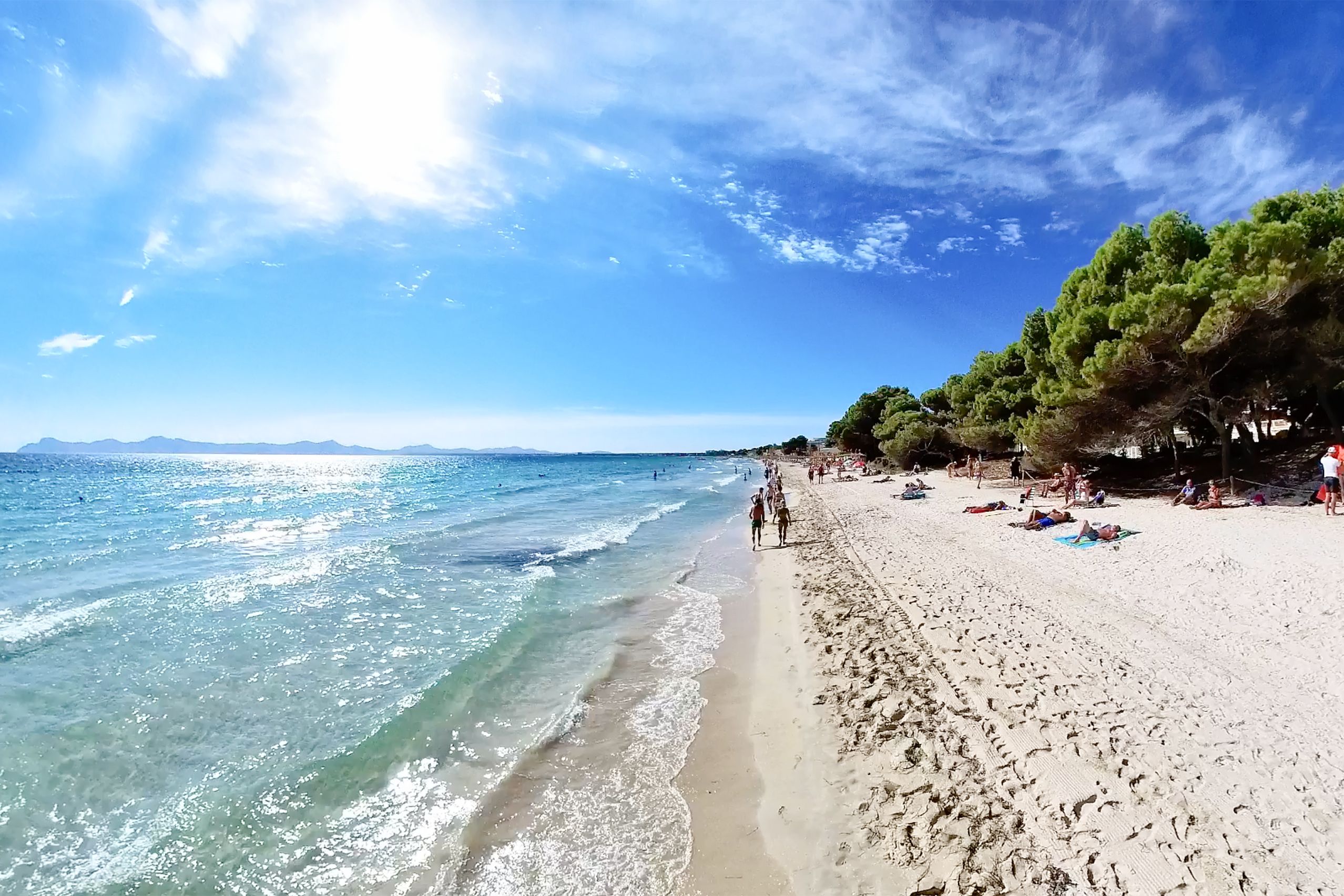
Five kilometres of pale sand shelving gently into the sea, backed by hotels, bars and shops. A classic beach holiday on Alcúdia bay, with a medieval walled town just two kilometres inland.
Port d'Alcúdia
Port d'Alcúdia in 30 seconds
The essentials at a glance
Sunshine, sand and everything nearby.
- Worth a visit?
- Yes — ideal for a classic beach holiday
- Best for
- Families, beach holidays and everything close by
- Best months
- April–June, September–October
- Best time of day
- Morning or late afternoon
- Time to allow
- A week as a holiday base, or three hours for a visit
- With children
- Very good — gently shelving water
- Without a car
- Easy enough
- Parking
- Limited from late morning in summer
- Highlight
- Exceptionally shallow water at the beach
- Keep in mind
- High-summer peace or traditional Mallorcan town life
- Access
- Level promenade; harder going on the sand
Get a feel for Mallorca. Find your kind of place.
Two places, one name
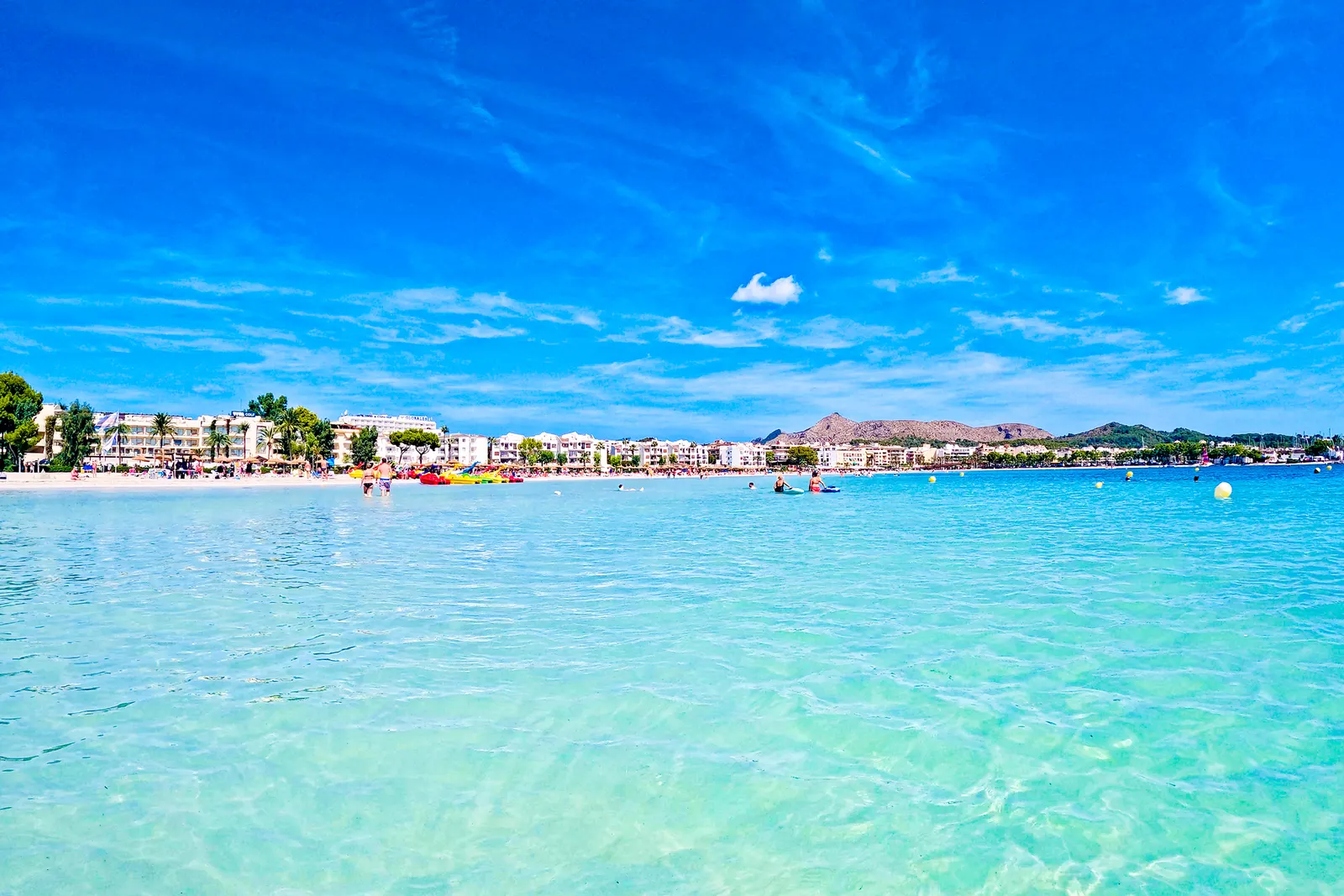
Port d’Alcúdia is by the sea. Historic Alcúdia, with its lanes and medieval walls, lies inland. It is easy to combine a beach holiday with a visit to the old town.
The beach
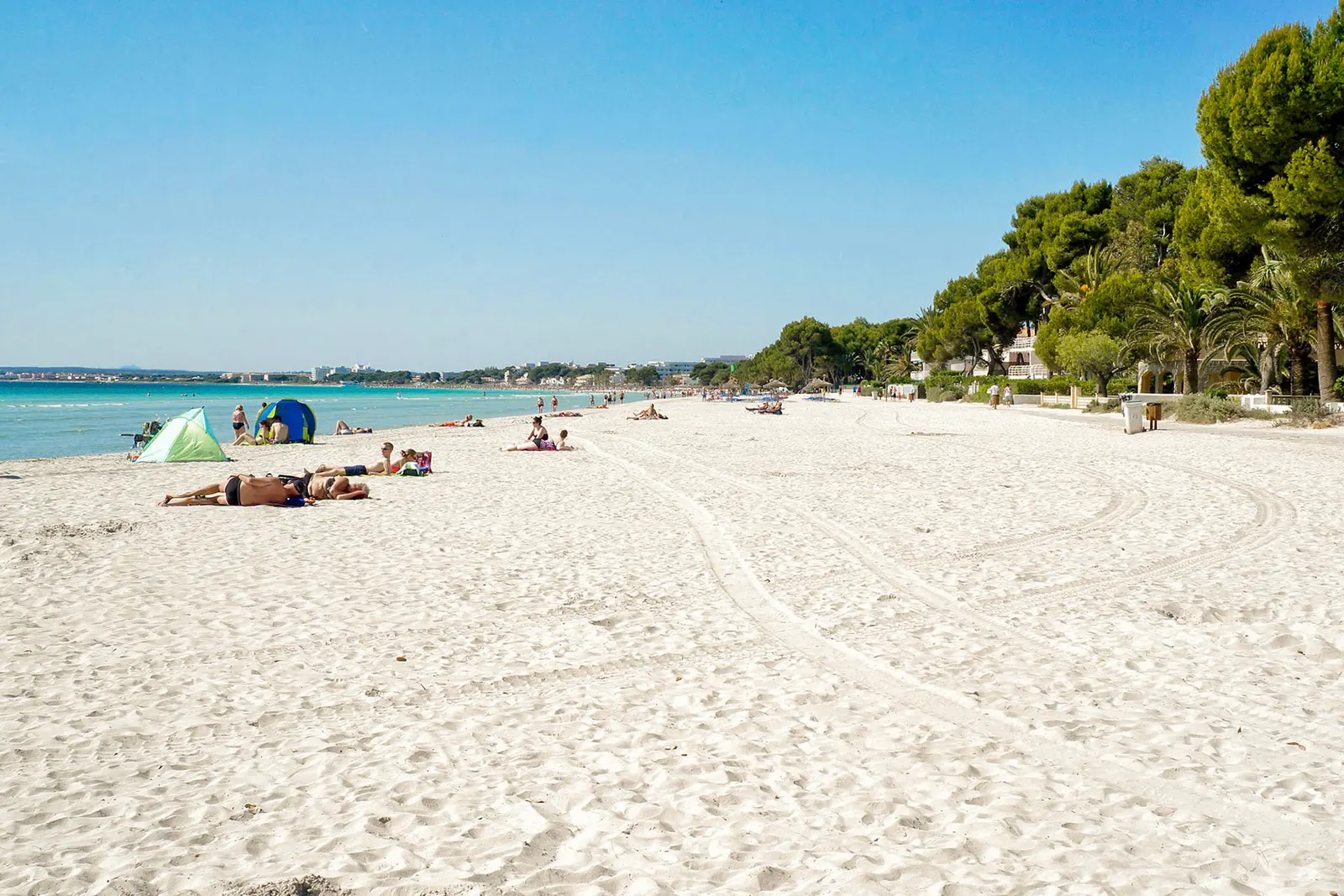
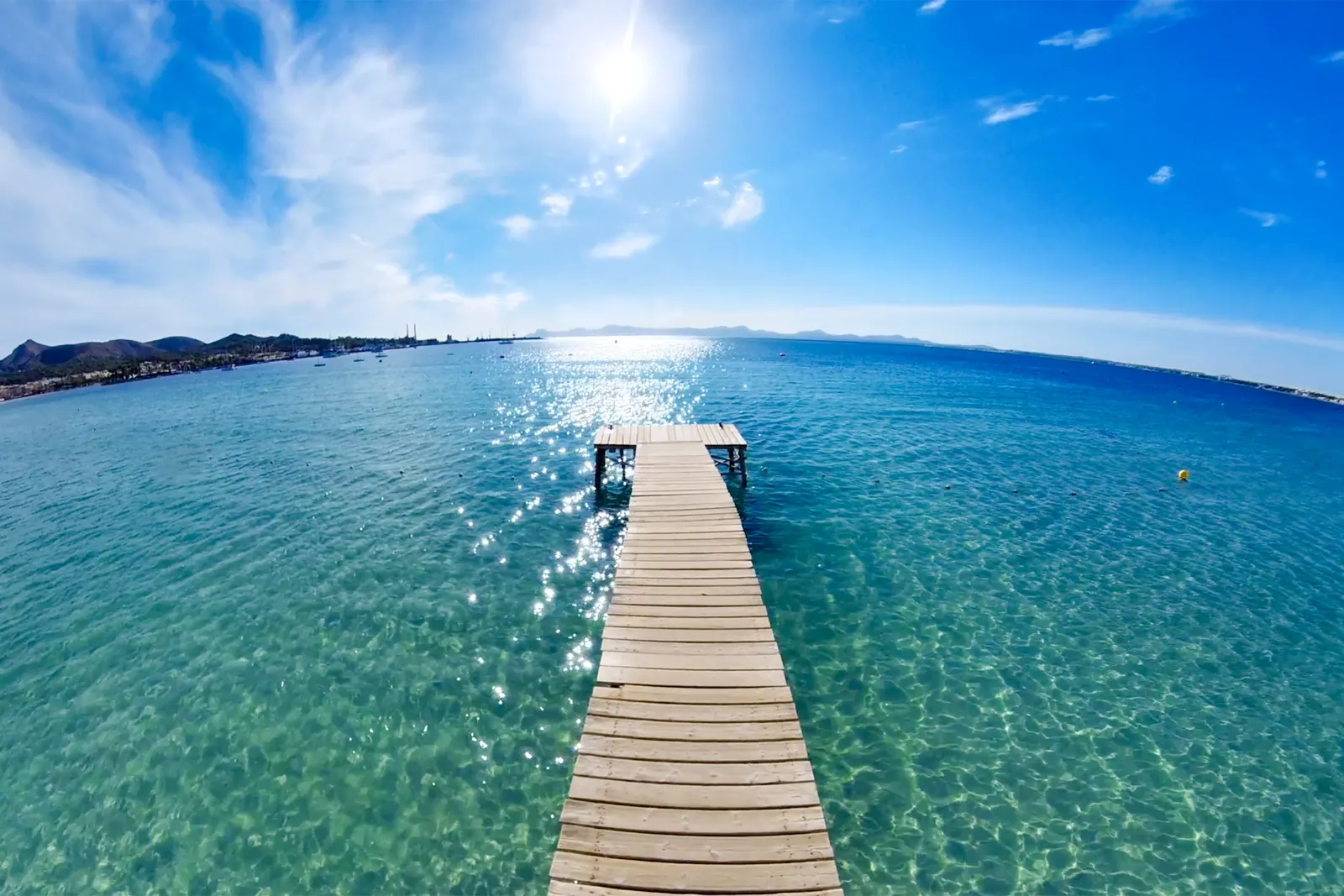
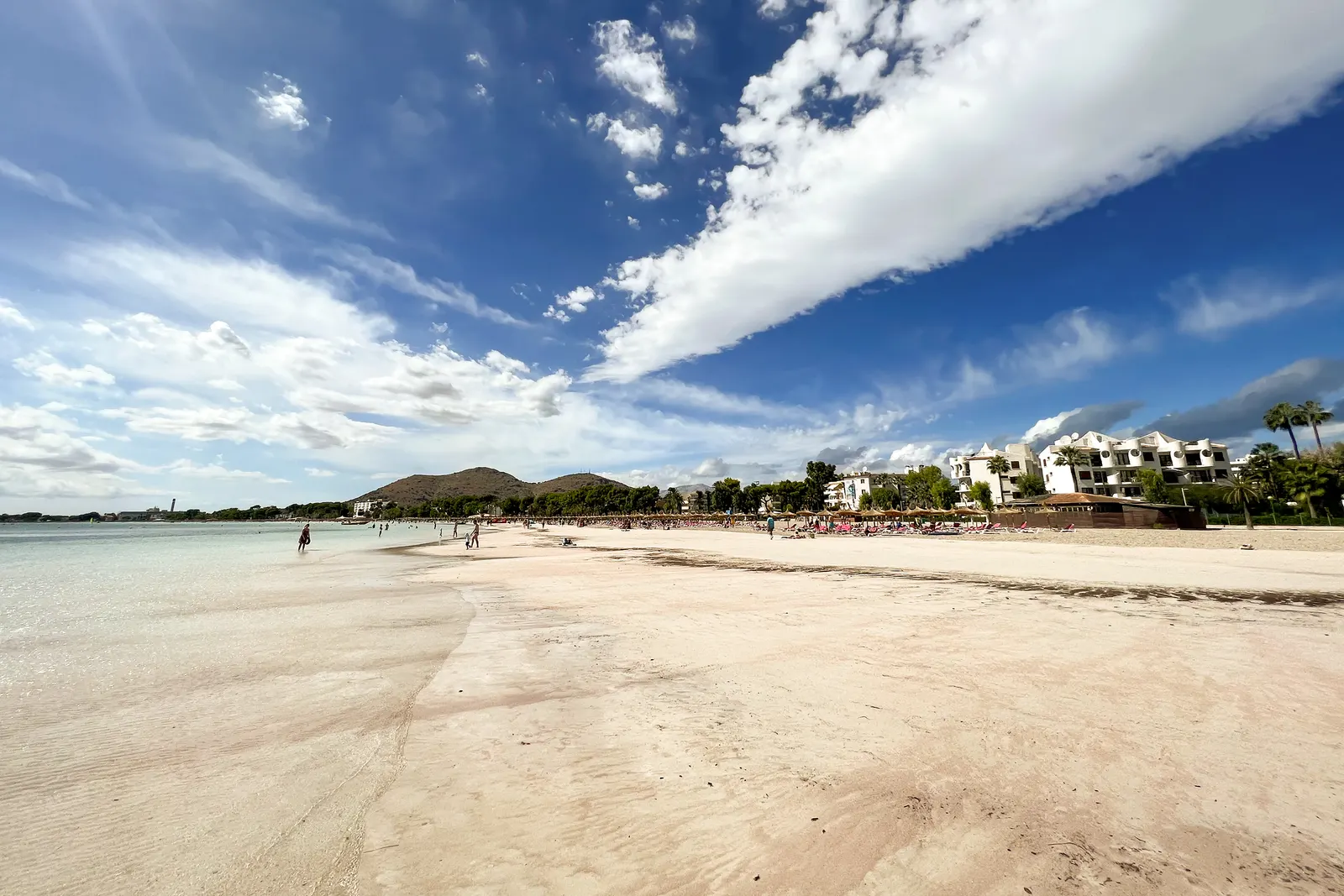
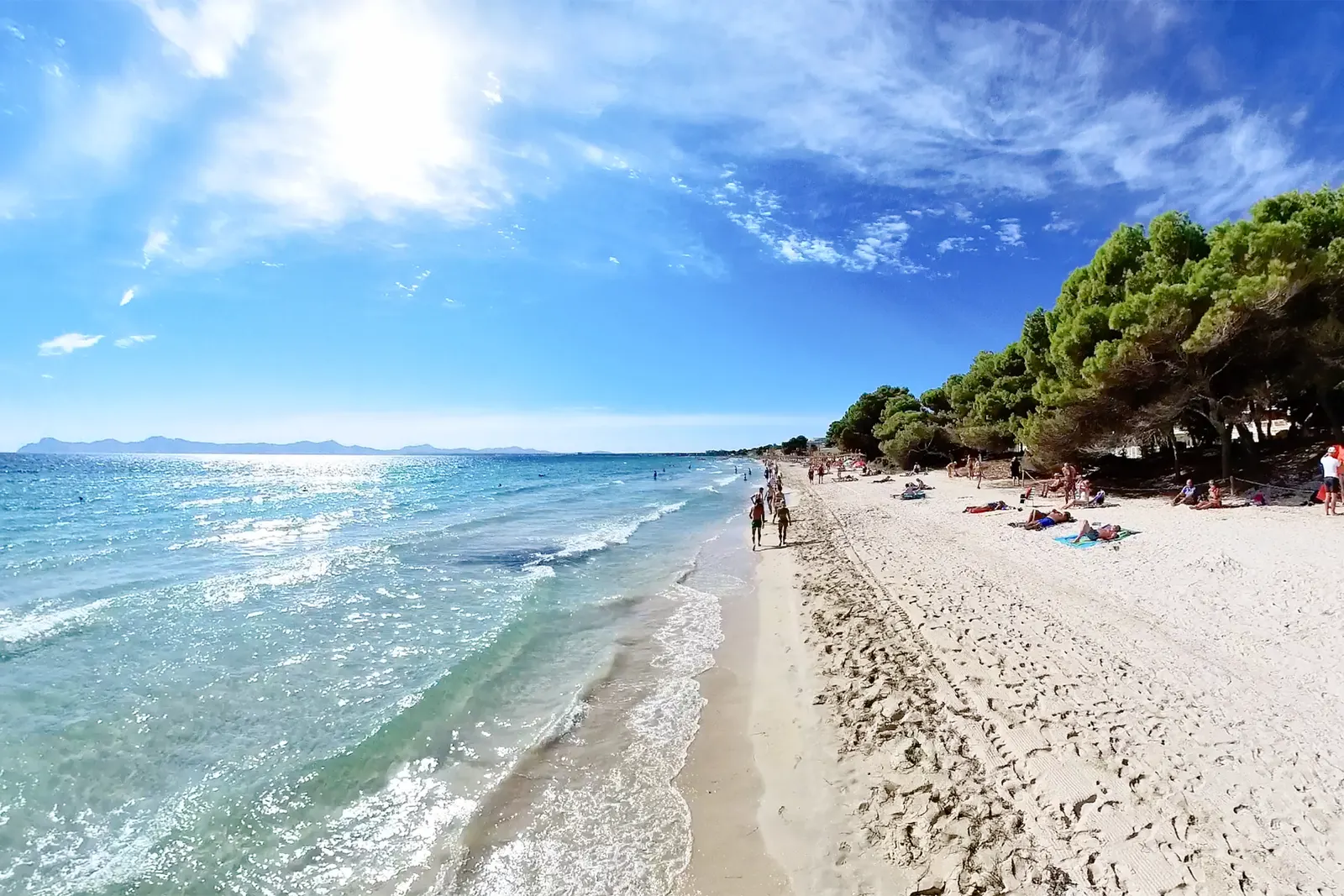
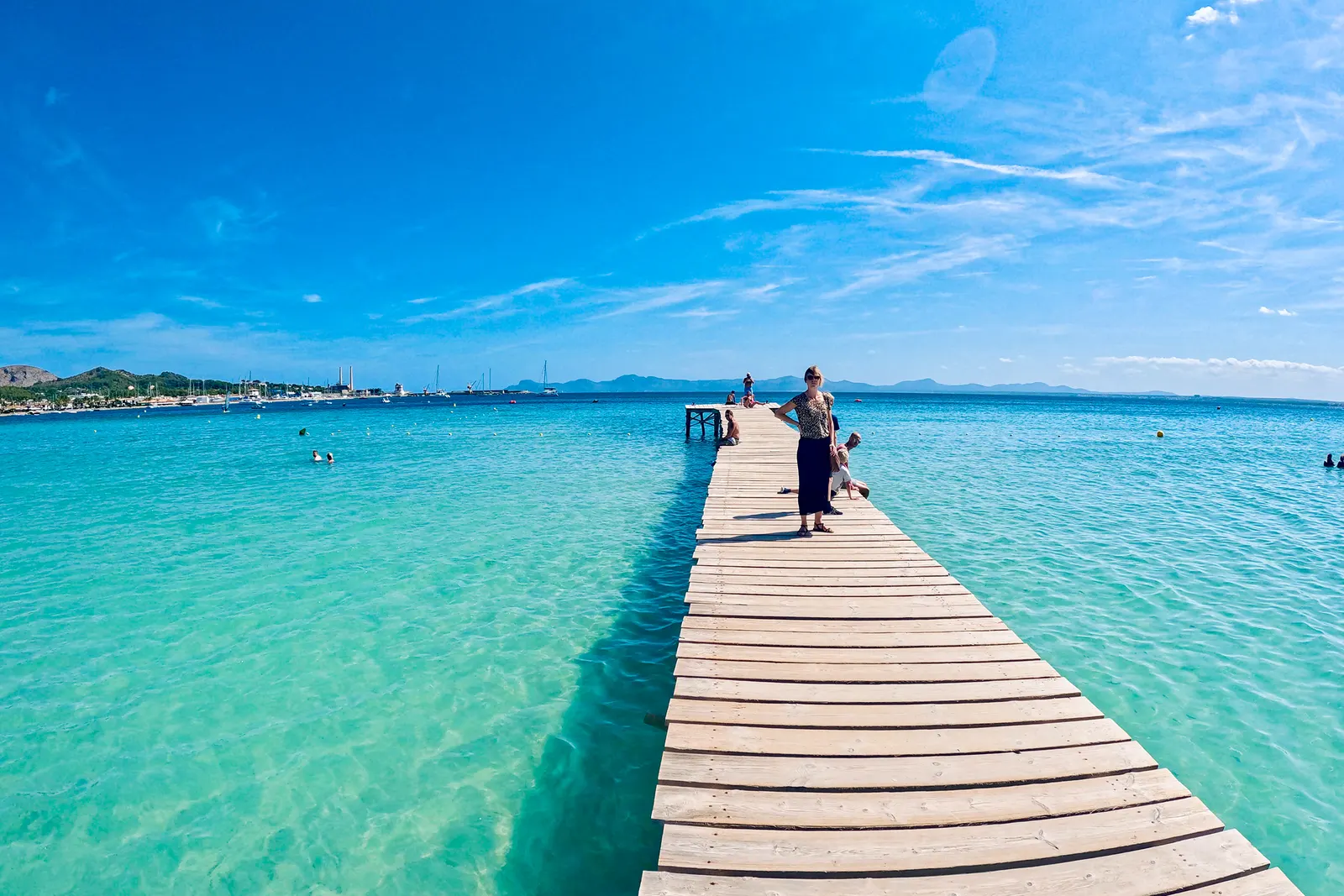
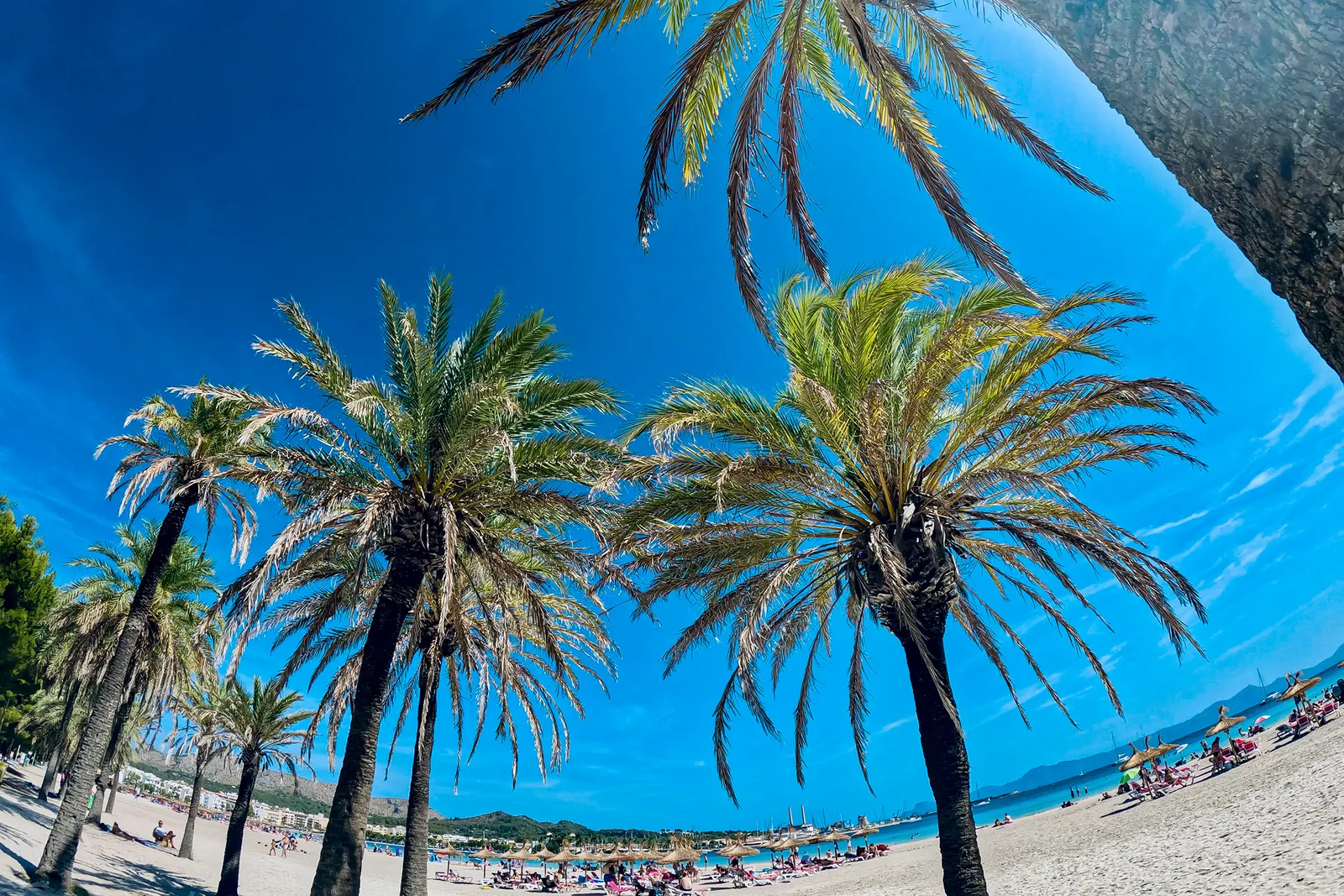
Pale sand and gently shelving water line the bay. Hotels, beach bars and the route back to your accommodation are close by, making a day at the beach straightforward.
The promenade and harbour
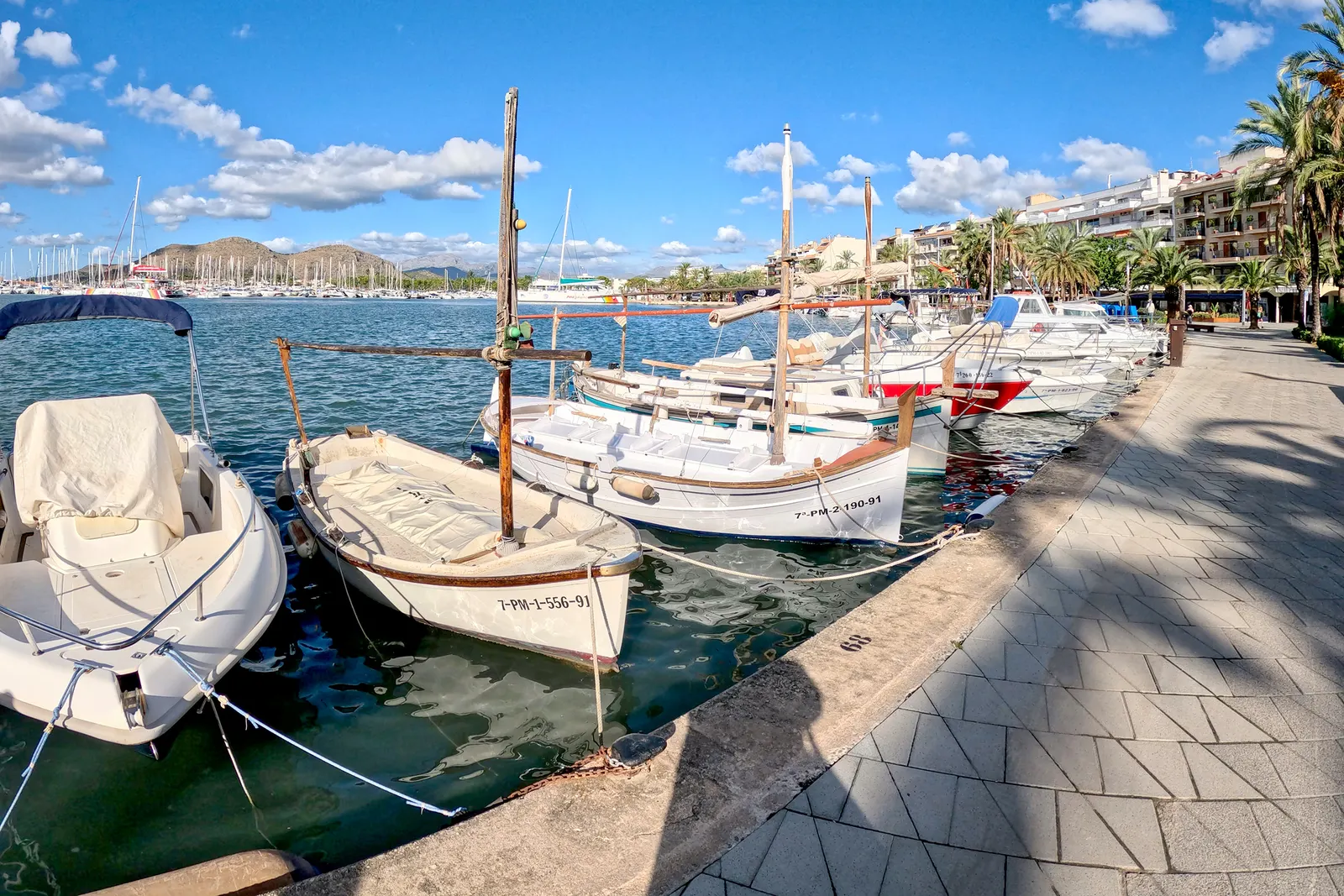
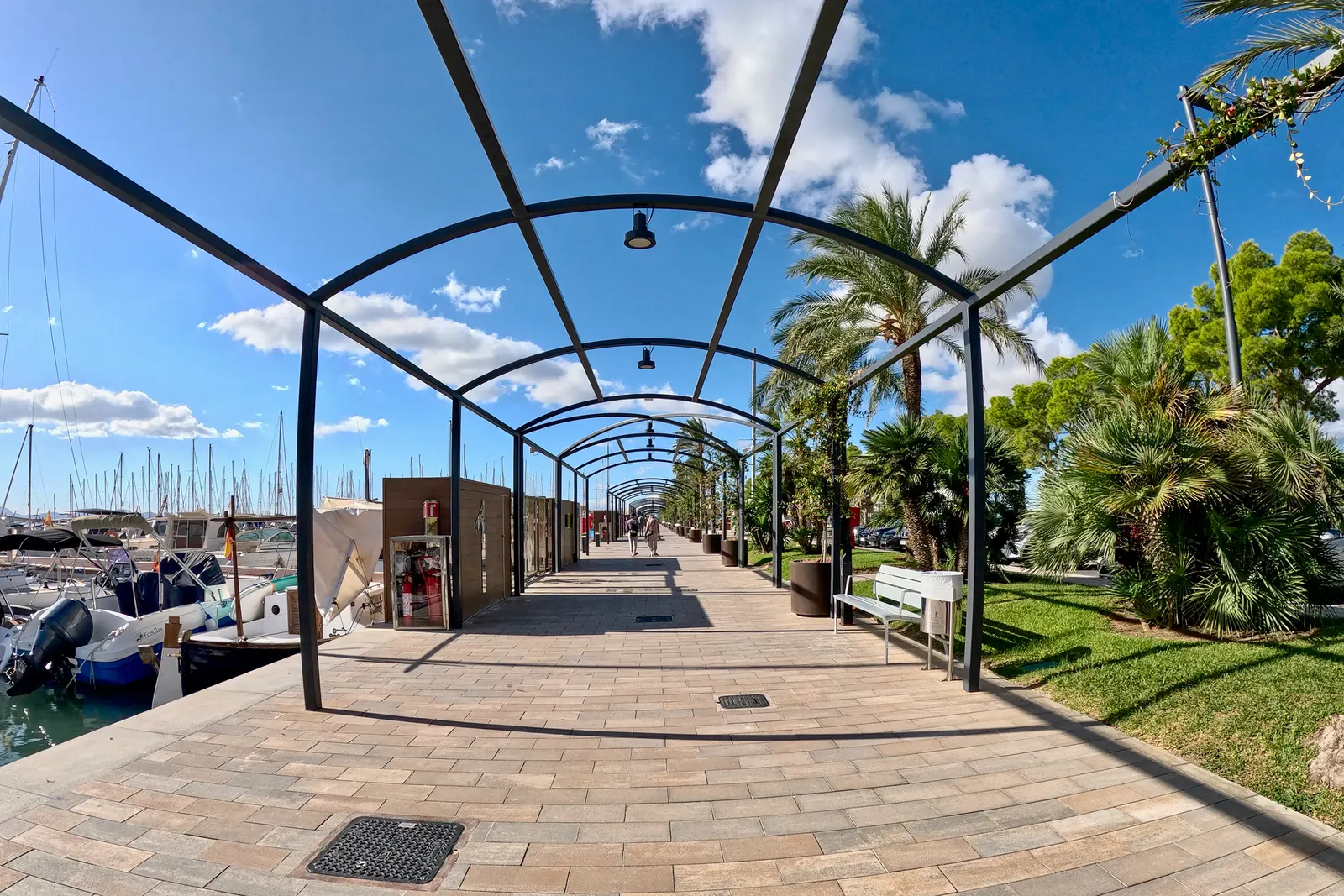
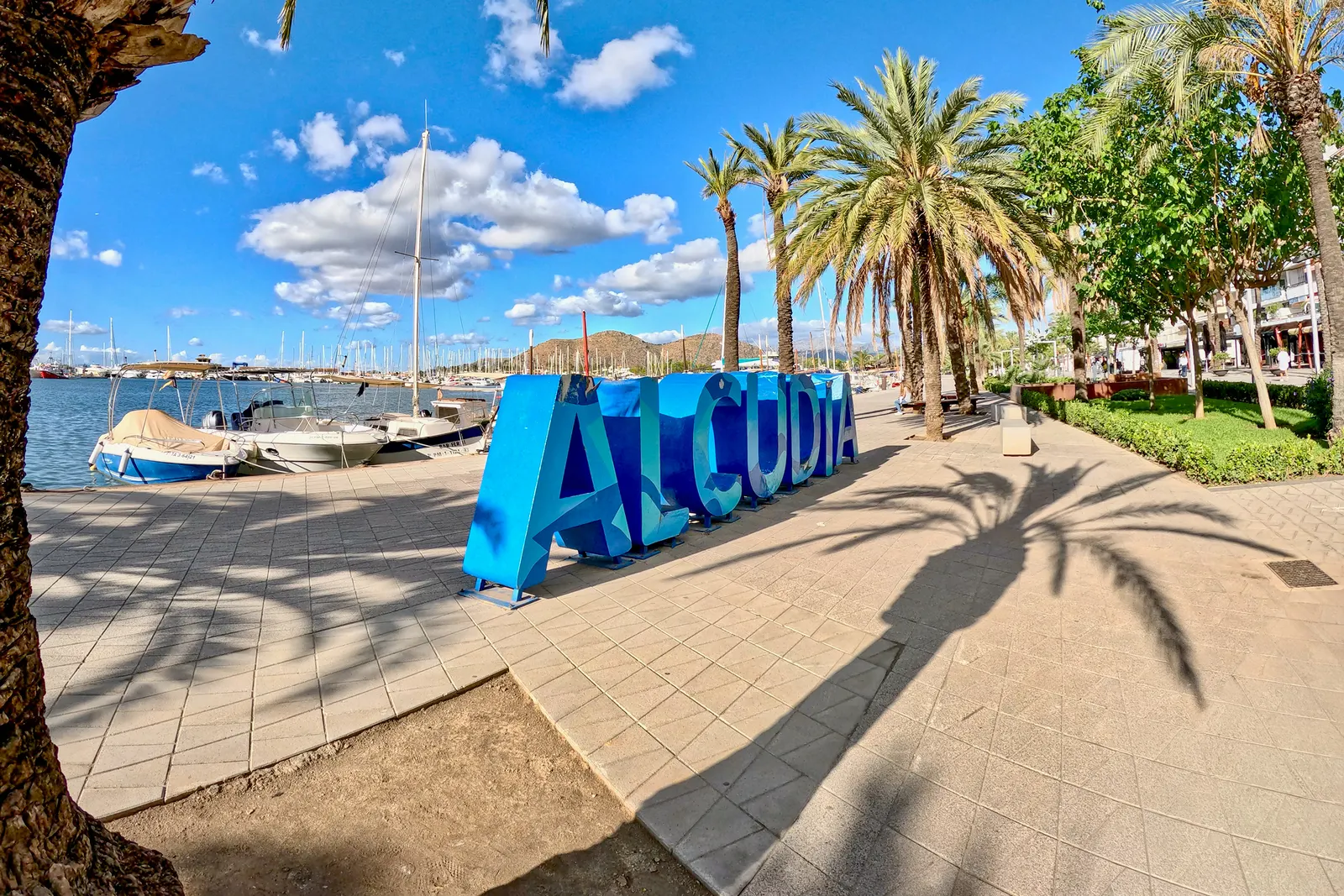
The promenade is a lovely place to finish a beach day. Traditional llaüts lie beside modern boats in the harbour, with cafés and restaurants close by.
Getting to know Port d'Alcúdia
Does Port d'Alcúdia suit your plans?
What to expect and what to know before you visit.
You will feel at home here if…
- you are travelling with children and want a sandy beach with gently shelving water.
- you enjoy beach holidays with accommodation, restaurants and the promenade close together.
- you want a holiday without a hire car and use buses for day trips.
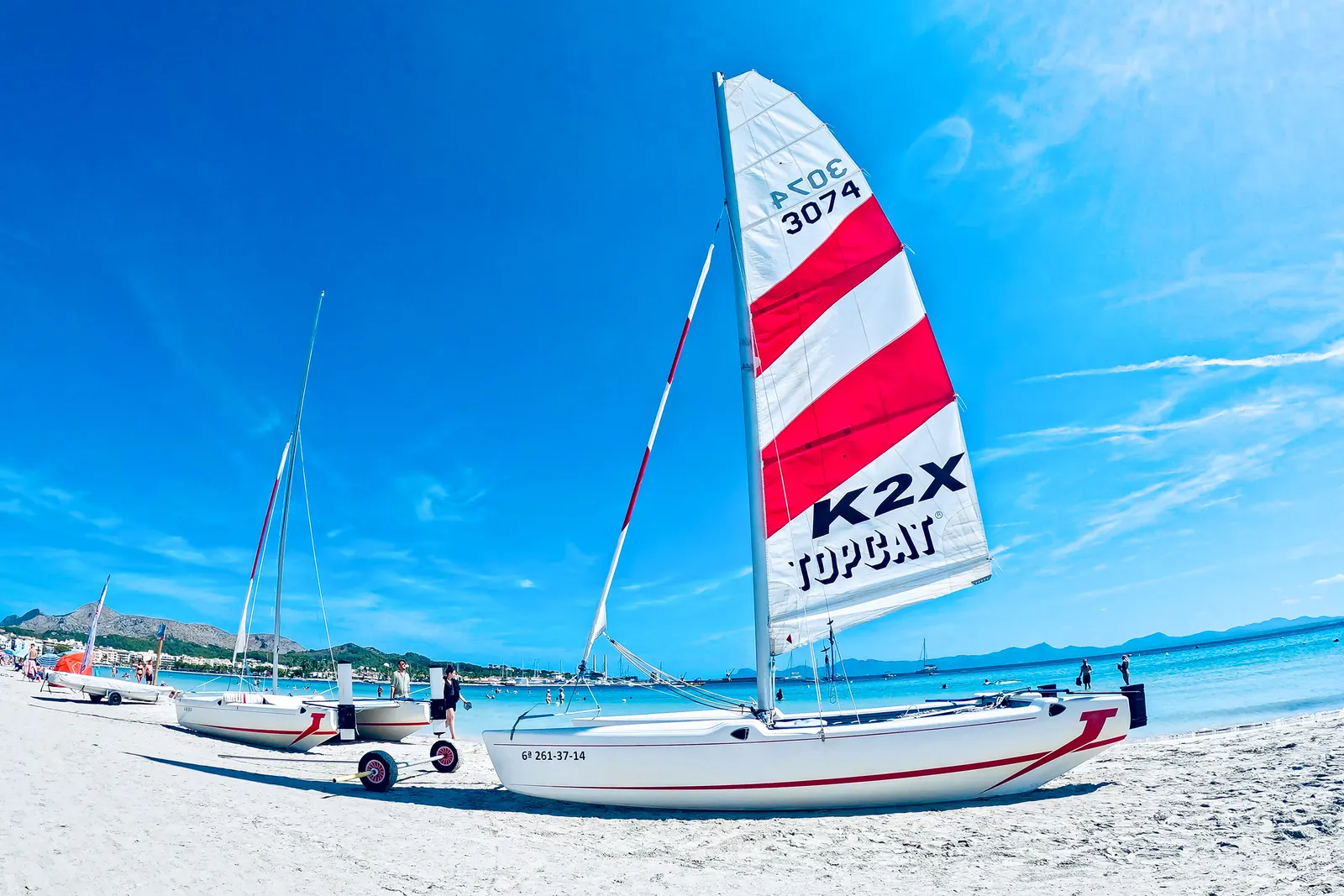
- you enjoy water sports, cycling or sailing.
Less suitable if…
- you want plenty of peace and quiet: in high summer the resort is lively and busy.
- you want historic lanes: the old town is in neighbouring Alcúdia.
- you visit in winter: it is much quieter, with many hotels and restaurants closed.
- you prefer little rocky coves: a long sandy beach defines the coast here.
Drive from the airport
50 minutes
58 km
Bus connections
Airport bus A32 in the summer season and A33 in winter
Region
Raiguer
Nearest beach
Alcanada
2 km
Elevation
2 m
above sea level
Season guide for Port d'Alcúdia
November Worth considering
Most hotels and restaurants gradually close.
Quiet Some places closed
Worth visiting in April, May, June, September and October. Less suitable in January, February and December. Mostly closed in January, February and December.
Location
Location of Port d'Alcúdia
- Region
- Raiguer
- Municipality
- Alcúdia
- Elevation
- 2 m above sea level
- Airport
- 58 km , around 50 minutes
- Hire car
- not essential
- Worth visiting for
- a longer stay
- Coordinates
- 39.8418,3.1329
Two places, one name
Port d’Alcúdia is the seaside resort, with hotels stretching along five kilometres of beach. Alcúdia, the town that gave it its name, sits two kilometres inland behind medieval walls. Many holidaymakers spend their entire week without visiting it.
Before tourism, this really was Alcúdia’s port. Today the waterfront mainly serves visitors. The commercial harbour lies further east, where ferries leave for Menorca and industrial buildings line the walking route towards Alcanada.
The beach
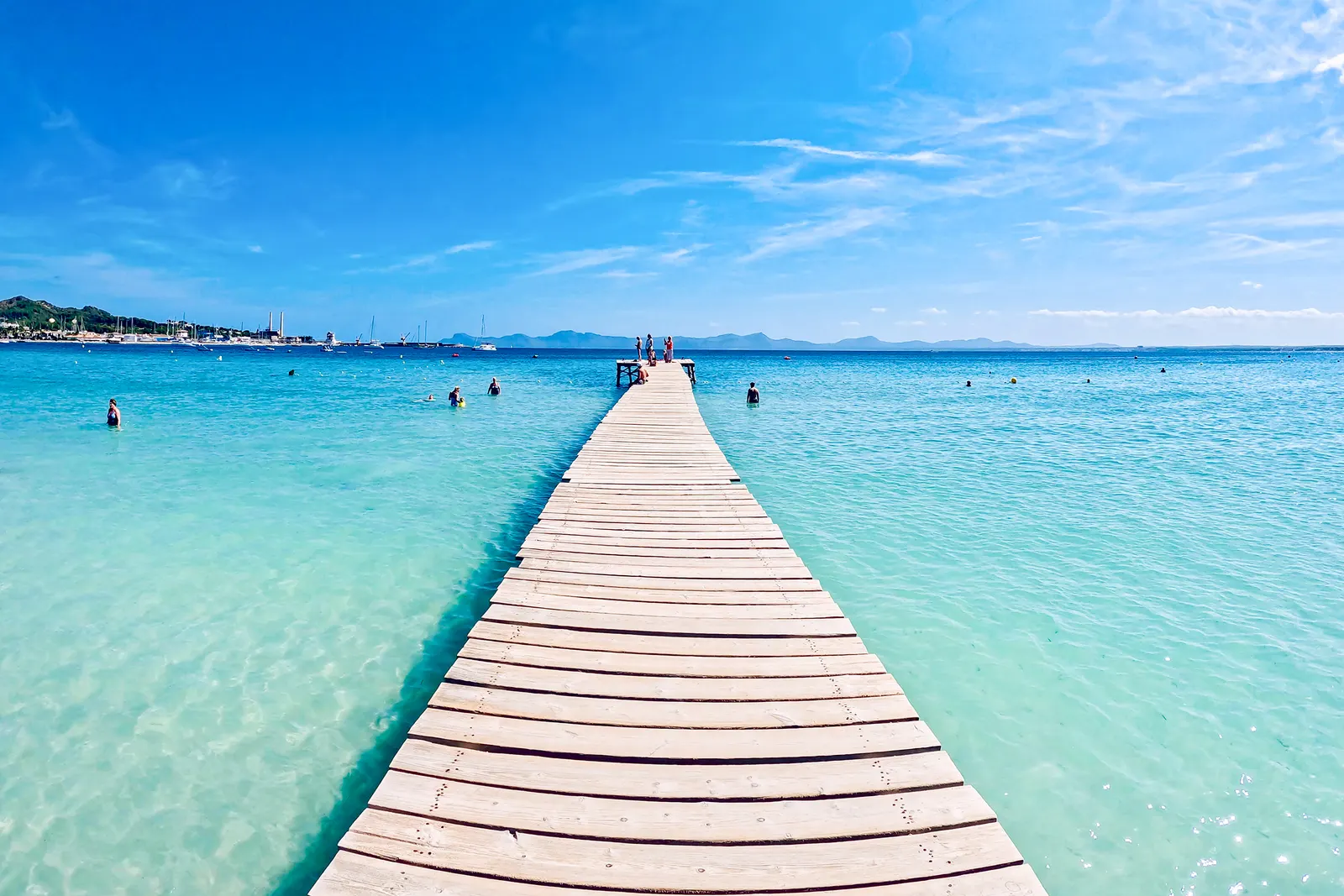
The beach is why people come, and its shape makes it exceptional. Mallorca has plenty of beautiful beaches, but here the sand shelves so gently that, in calm conditions, you can walk a hundred metres out before the water reaches your waist. For families with young children, it is hard to beat.
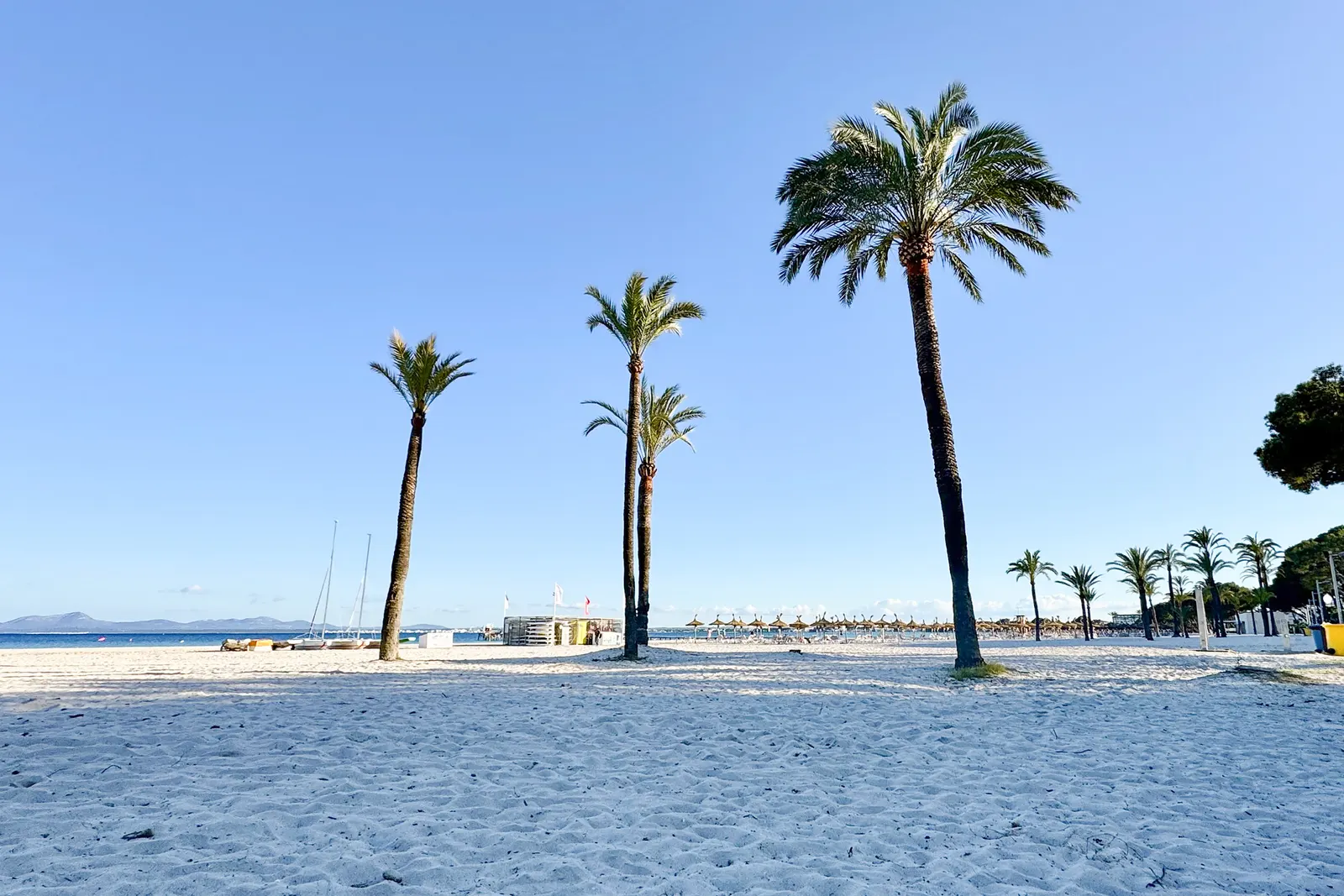
The sand is fine, pale and free of stones, raked every morning in season. The numbered balnearis provide sunbeds, parasols and showers, and have recently been rebuilt. Their numbers are useful landmarks: arranging to meet at Balneari 4 is much easier than giving a street address.
Do pay attention to the beach flags. A northerly wind brings waves into the bay, and shallow water can give a misleading impression of safety. Follow the lifeguards’ advice.
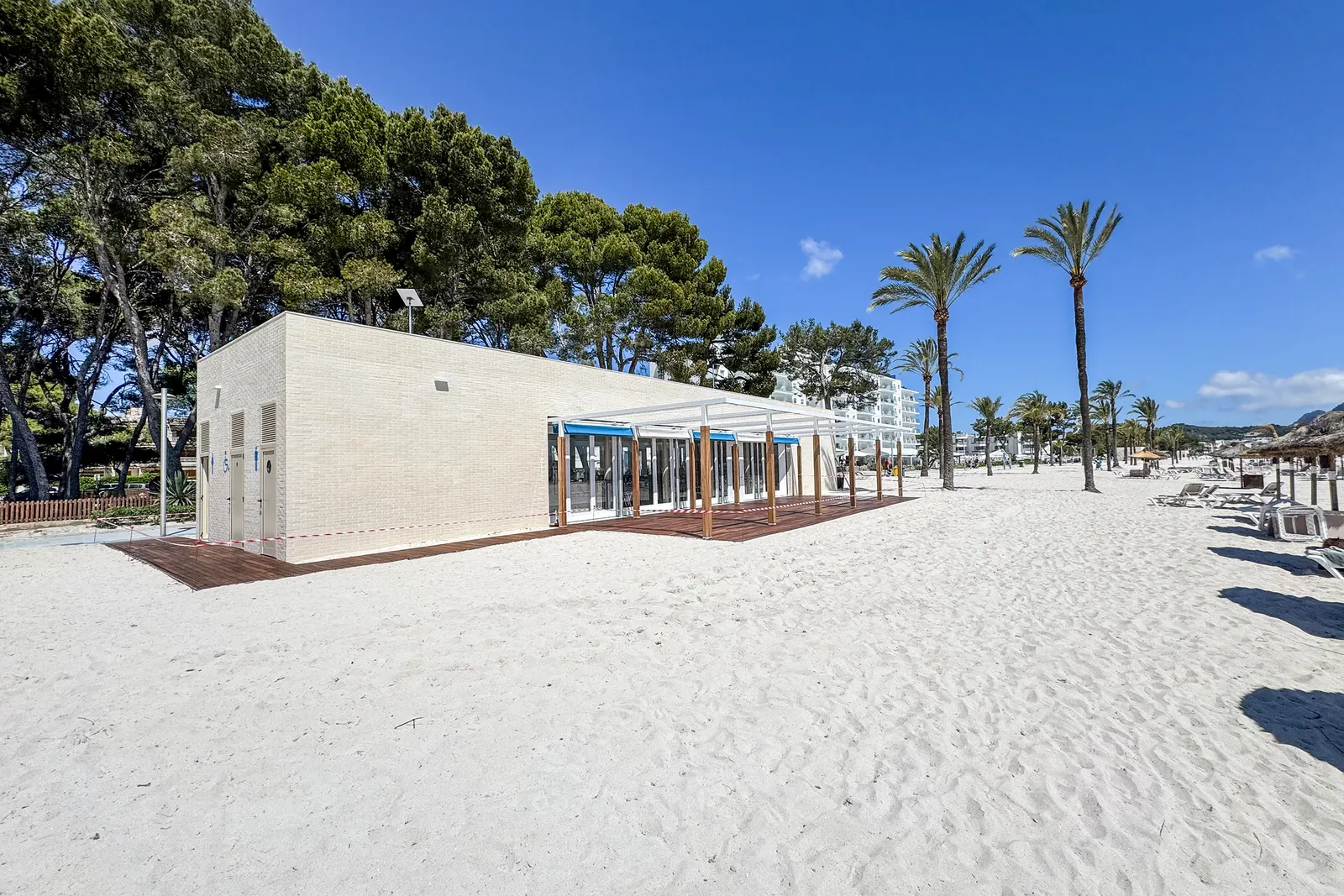
Finding a quieter stretch
Early morning is usually quieter than the middle of the day. You can also walk along the bay towards Platja de Muro to try a different section. There is no fixed point beyond which the beach becomes empty; that stretch can be lively in high summer too.
Between November and March, the beach is much quieter. Seagrass remains along the shore, hotels close and you may walk for kilometres almost alone. It can be beautiful, but the busy holiday resort has largely shut down around it.
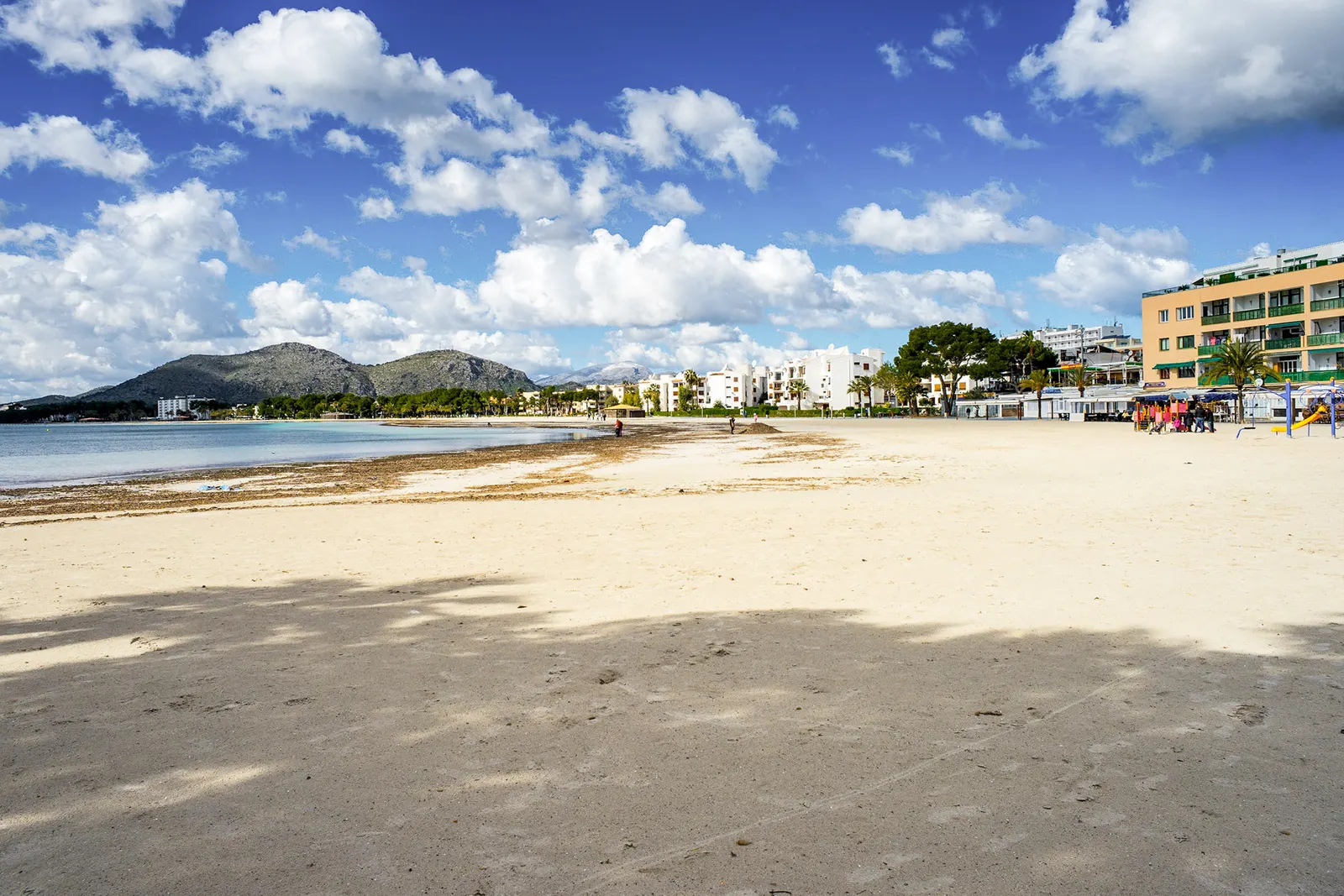
The promenade and harbour
Passeig Marítim runs from the beach to the marina, broad, paved, palm-lined and level throughout. A few wooden llaüts, the traditional Mallorcan fishing boats with their high curved bows, remain among the motorboats. Further along, an arched steel structure covers the path, providing welcome summer shade.
Continuing east eventually brings views of Illa d’Alcanada, the small offshore island with its lighthouse. The walking route passes industrial buildings, however. By bike or car, Carrer Gabriel Roca and Camí d’Alcanada make a more pleasant approach.
Easy things to miss
Behind the coastal road lies S’Albufera, the Balearics’ largest wetland. Its channels and reedbeds support more than two hundred bird species, within a short cycle ride of the beach. Many visitors pass it all week without realising what is there.
Then there is Alcúdia itself. Two kilometres away, or five minutes by bus, you find medieval walls, sandstone lanes, the Roman excavations of Pollentia and markets on Tuesdays and Sundays. If you make just one trip from the resort, make it this one.
Evenings
In summer, the main road is bright, noisy and busy. Restaurant signs glow, terraces spread towards the pavement and bike hire shops sit beside grill restaurants. Families with pushchairs are still out at ten in the evening.
That is the atmosphere here, and it is useful to know whether it suits you. For a quieter evening, try the waterfront a couple of hundred metres away or choose a different resort. If you enjoy activity around you, this may be just right.
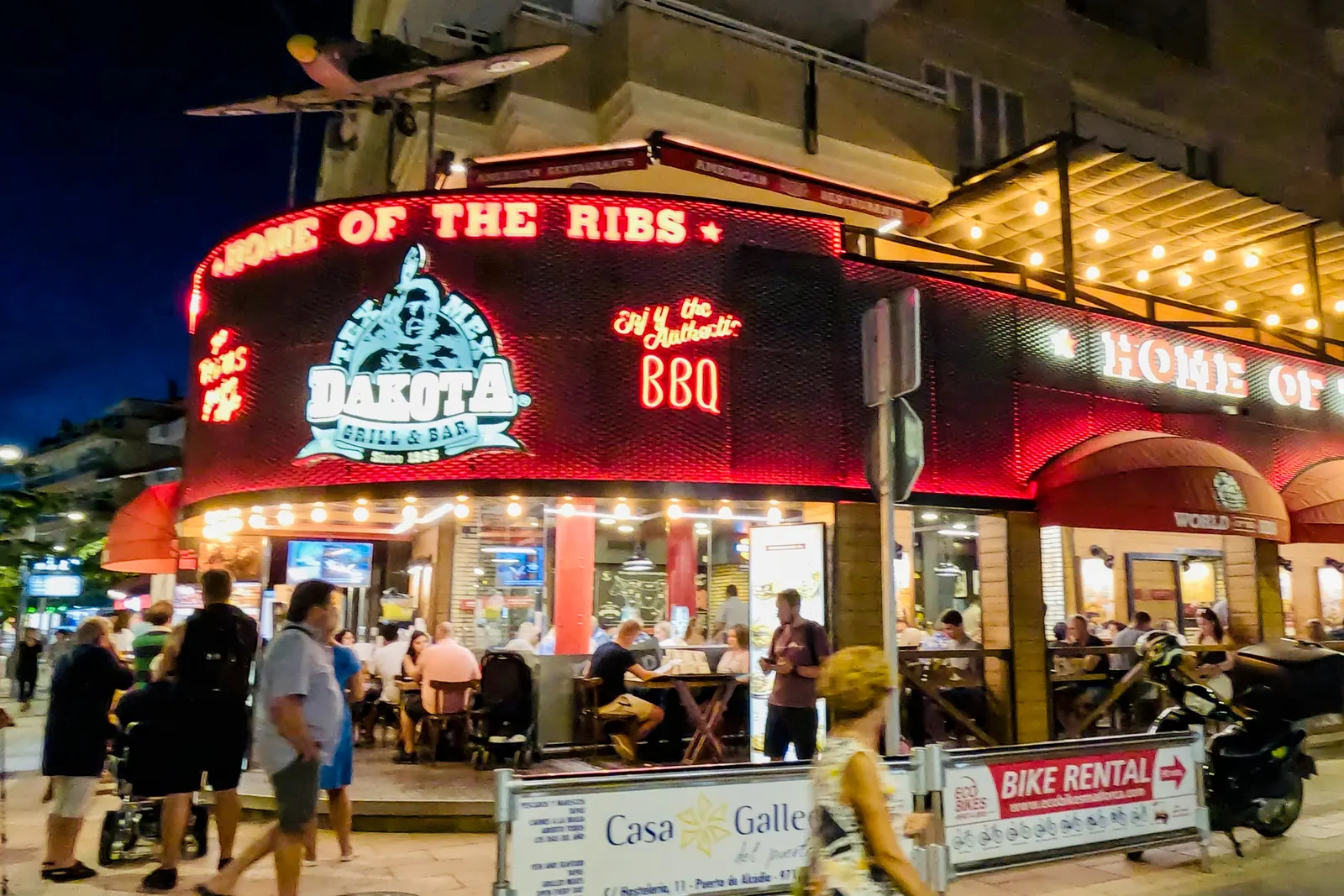
Day trips
Port d’Alcúdia is a very useful base for exploring. Alcúdia is close by, and buses reach Pollença and Port de Pollença. Cap de Formentor is under an hour away; Artà and the eastern caves are a little over an hour. Route 302 goes directly to Palma.
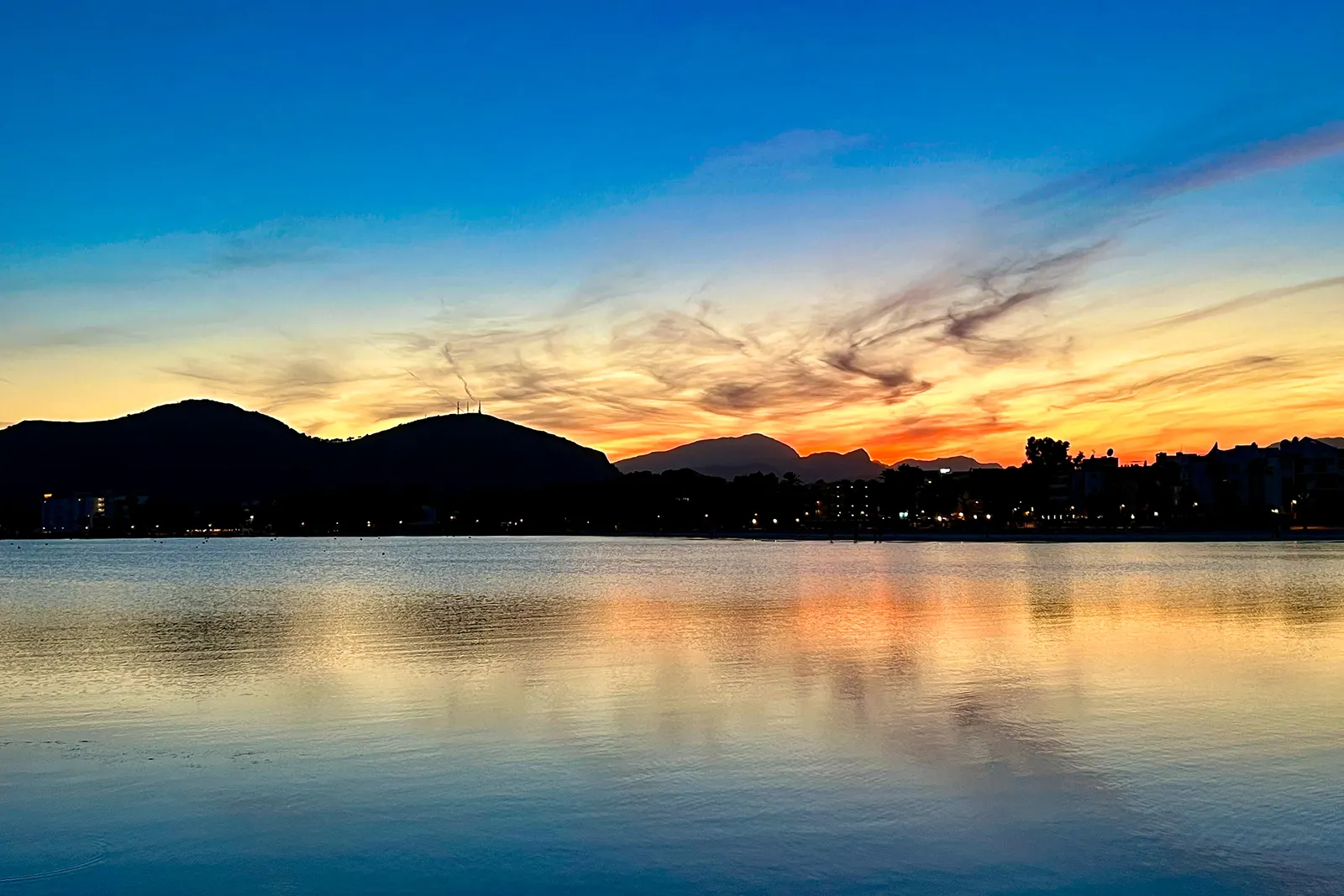
The Tramuntana remains in view throughout the day. In the evening, the sun sets behind it.
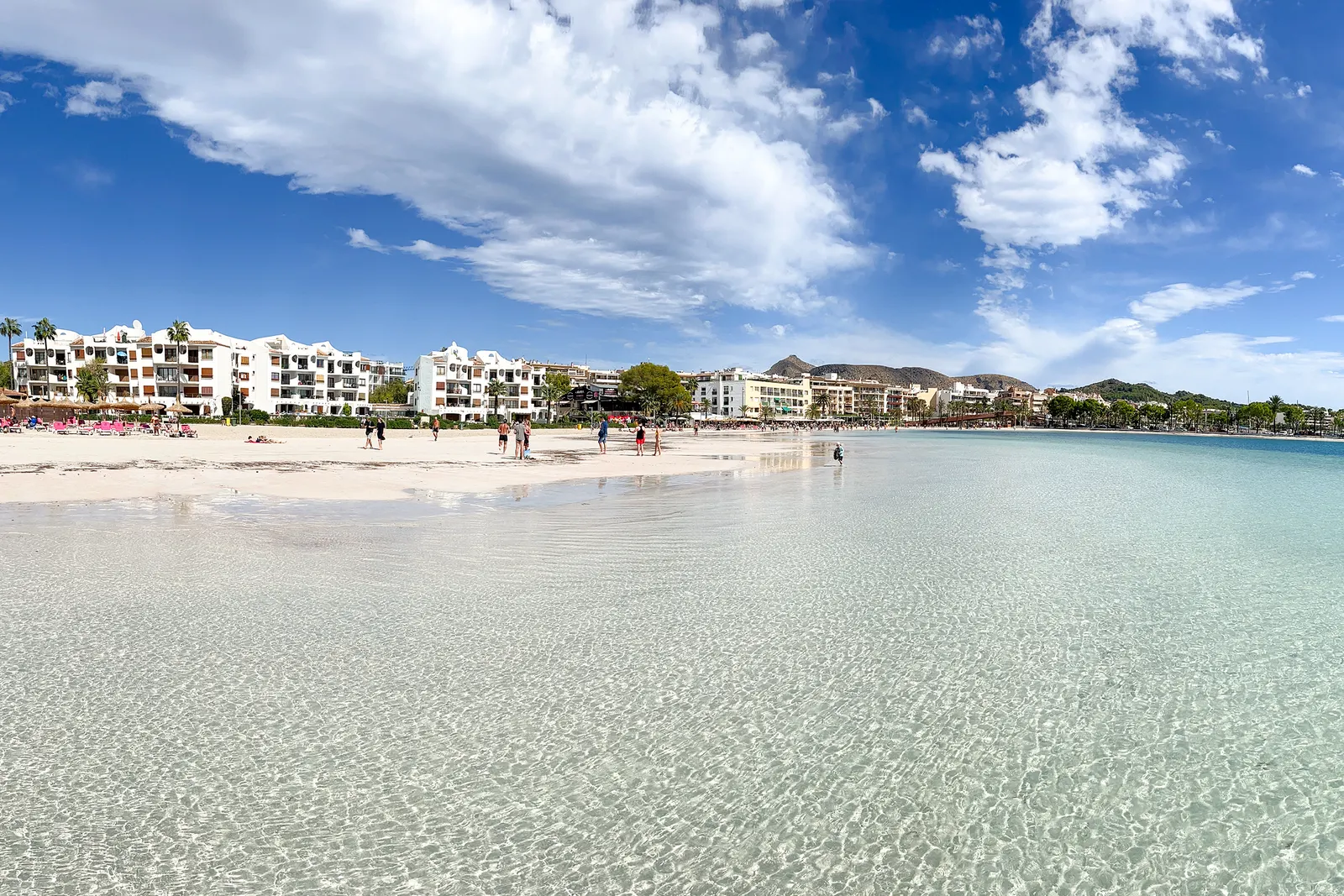
Photographs
Port d'Alcúdia in Mallorca
Time for your holiday plans
Things to do in Port d'Alcúdia
Three hours
Spend the morning on the beach, then follow the promenade to the marina and back. You could continue the two kilometres inland to Alcúdia's old town.
Half a day
Beach in the morning, then a bus to Alcúdia for the walls, lanes and Pollentia. Return to the water in the late afternoon.
A full day
Start early on the beach while it is quiet. Visit Alcúdia or Ermita de la Victòria around midday, then cycle to S'Albufera nature reserve behind the coastal road. Spend the evening on the promenade.
On a rainy day
Visit a museum in Alcúdia, then settle into a café. Check opening times first. Pollentia's excavations are outdoors and better saved for dry weather.
The beach at a glance
- Underfoot
- Fine pale sand without stones
- Getting into the water
- Very shallow — in calm conditions you can walk a hundred metres out before the water reaches your waist
- Length
- Around five kilometres, continuing into Platja de Muro without a break
- Shade
- Hired parasols and the strip of pines along the edge
- Wind
- Often calm with offshore winds, but a northerly can bring waves — follow the beach flags
- With children
- Exceptionally gently shelving water
- Facilities
- Numbered balnearis with sunbeds, parasols and showers · Lifeguards in season · Watersports centres · Beach bars
Practical details
Current bus routes and timetables at TIB ↗
- Parking
- Paid zones by the promenade fill from late morning in summer. Free spaces are available further back in residential streets, about five minutes' walk away.
- Public transport
- Stops along the main road, with frequent services in season
- Time to allow
- A week as a holiday base, or three hours for a visit
- Good to know
- The beach facilities, known as balnearis, are numbered. On a five-kilometre beach, meeting at Balneari 4 is much easier than using a street address.
- Bus
- Airport bus A32 in the summer season and A33 in winter. Route 302 connects with Palma, 322 with Port de Pollença and Pollença. Seasonal route 325 runs towards Cala Ratjada. Check the current TIB timetable before travelling.
- Shops and services
- Supermarkets: Several large supermarkets on the main road, open year-round · Pharmacy: Several on Carretera d'Artà · Medical care: Health centre in Alcúdia, 2 km away · Cash machines: Plenty along the promenade and main road · Fuel: On the road towards Artà
- Access
- Continuous level, paved promenade · Pushchairs: Easy on the promenade; difficult on sand · Wheelchairs: Accessible promenade, with wooden boardwalks onto the sand at several balnearis · Dogs: Not allowed on the main beach in season
- What you will not find
- An old town or historic centre — that is in Alcúdia · Peace in the main season · Rocky coves · Many facilities open between November and March
- Coordinates
- 39.8418,3.1329 Google Maps Apple Maps
Dates that change the town
When a race comes to town
Mallorca 312 Road cycling · 25 April 2026
Road closures begin in the morning. The affected roads and reopening times follow the organiser’s traffic plan. Allow extra time for transfers and day trips.
Ironman 70.3 Alcúdia-Mallorca Triathlon · 9 May 2026
Temporary closures and extra crowds affect the start, finish and race route. Check access to your accommodation and the course map, especially if you have an airport transfer.
The season guide describes whole months. A race weekend can transform a normally quiet town for a couple of days. Find the dates in our guide to Sporting events.
Three sections of the bay's beach
| Section | Character | Best for |
|---|---|---|
| Port d'Alcúdia | Hotels beside the sand and full facilities with numbered balnearis | Having everything on your doorstep |
| Platja de Muro | Pines and dunes with a nature reserve behind | More space including in summer |
| Can Picafort | A more compact and livelier resort | Lower-cost holidays |
The sections merge into one beach of around ten kilometres. The differences are mainly in what stands behind the sand, rather than the beach itself.
Within reach
Places to visit
Nearby

The remains of an important Roman town just outside Alcúdia. An urban centre developed here after the conquest of …
in Alcúdia, on the road to Port de Pollença

A pilgrimage church on the Victòria peninsula, seven kilometres north-east of Alcúdia. The road ends at a …
narrow mountain road from Alcúdia

Mallorca’s best-known viewpoint stands 232 metres above the sea on the Formentor peninsula. A terrace occupies a …
via Port de Pollença; in summer, after 10am only when the barrier is open
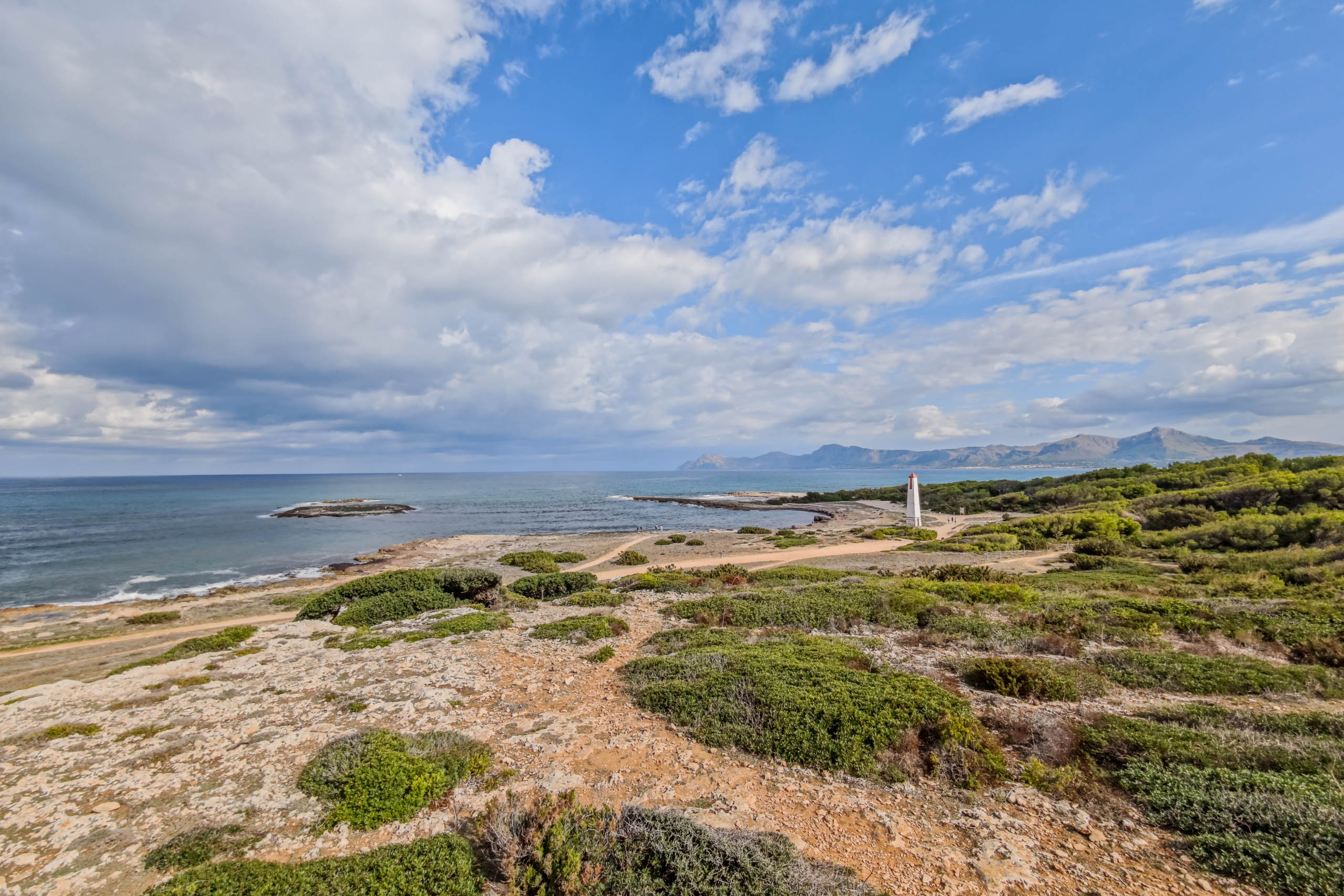
A few steps onto a wooden platform reveal the coast of Son Real. A dolmen lies beside the viewpoint, with the …

A Talayotic burial ground right beside the sea between Can Picafort and Son Serra de Marina. Around 110 tombs …
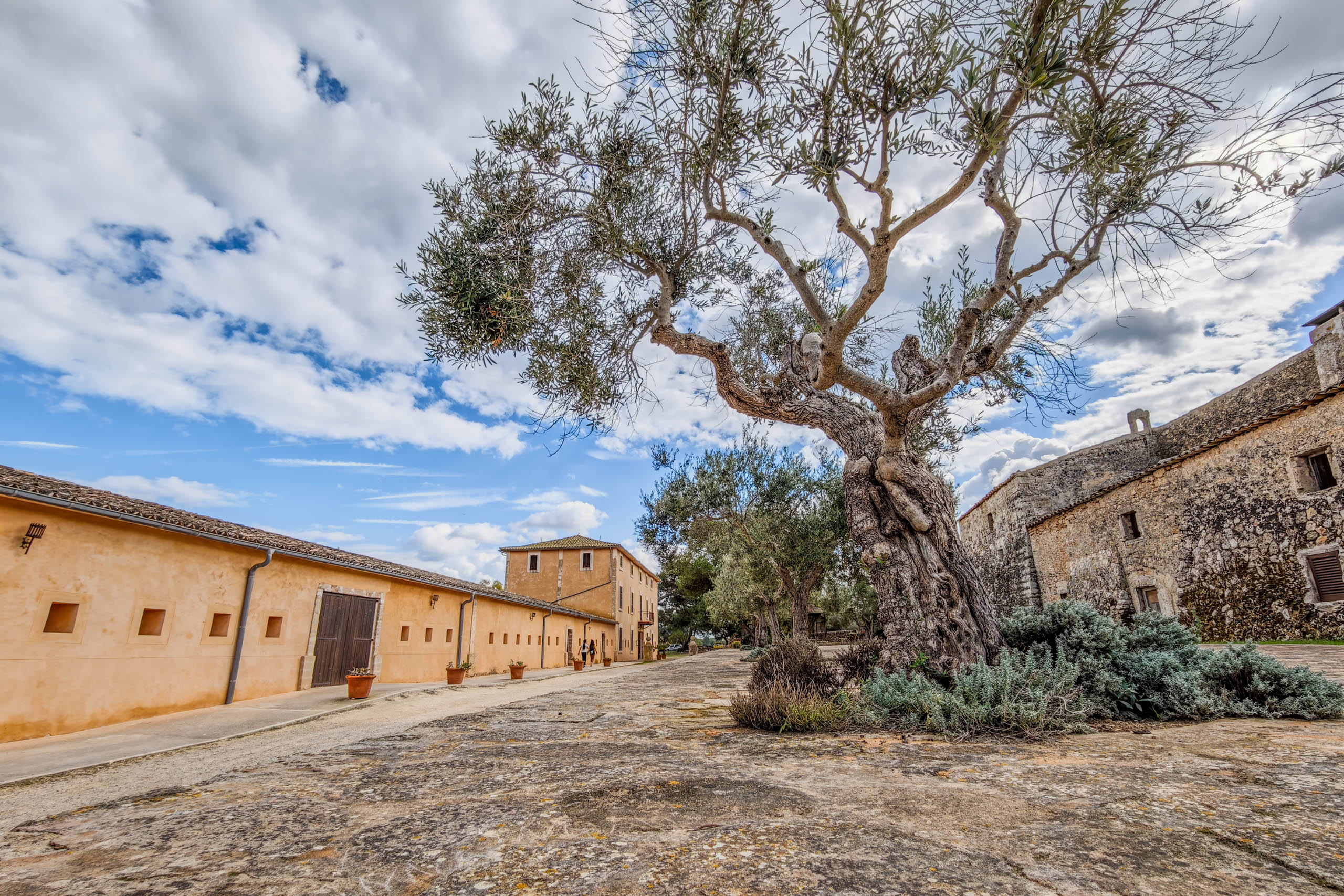
Old farm buildings, gnarled olive trees and a museum about earlier life on Mallorca. Son Real lies between Can …

A small pilgrimage chapel among pines near Sa Pobla, on the site of an older settlement. A paved path leads up to …

A church among the pines, beside the old Son Serra estate with its towers and farm buildings. A glimpse of the …
Distances without a driving time are measured in a straight line. The road journey can be much longer; known driving times are shown alongside.
Other beaches to consider
Beaches and swimming nearby

A quieter alternative to Port d’Alcúdia, 3 km to the east. Low villas sit among pines beside a pebbly, sandy shore …

A long sandy stretch of the Bay of Alcúdia, with protected dunes and pines at Es Comú rather than a continuous …

A small fishing settlement first recorded in 1860 has become a busy holiday resort. Come for the beach, the …

A quieter, more expensive neighbour to Alcúdia bay, with the waterfront Pine Walk, a royal yacht club and reliable …
Explore from here
Your questions answered
Your questions about Port d'Alcúdia
Is Port d'Alcúdia good for families with young children?
Yes. The fine sand is free of stones and the water stays shallow a long way out, while facilities cater well for families. In calm conditions, it can be only waist-deep a hundred metres from the beach. It is an excellent choice if easy swimming with young children is your priority.
What is the difference between Alcúdia and Port d'Alcúdia?
They are two places, two kilometres apart. Alcúdia is the medieval town with walls, narrow lanes and the Roman excavations of Pollentia. Port d'Alcúdia is the seaside resort that developed in the 20th century. Holidays sold as Alcúdia usually mean the port. The old town is five minutes away by bus.
How busy is Port d'Alcúdia beach?
Very busy in July and August, especially around the central balnearis. Arrive early or walk along the bay towards Platja de Muro. The amount of space varies by section and day.
Is Port d'Alcúdia worth visiting in winter?
I would not choose it for a winter resort holiday. Most hotels and restaurants close between December and February. The beach is still open and can be beautiful on a clear winter day, but the resort itself is very quiet.
Do I need a hire car in Port d'Alcúdia?
Usually not for a beach holiday. Depending on the season, airport buses A32 or A33 serve the resort, and other buses cover the bay. A car is useful for the Tramuntana, but consider hiring one for individual days rather than the whole week.
When is the market in Port d'Alcúdia?
Friday mornings on Plaça de Cas Vicari. Alcúdia old town holds its market on Tuesdays and Sundays. A summer evening market also takes place on Passeig Marítim; check dates before visiting.
Is Port d'Alcúdia a good base for day trips?
Yes. Alcúdia is two kilometres away, S'Albufera nature reserve lies behind the coastal road, and Cap de Formentor is less than an hour away. Pollença, Artà and the Tramuntana are all within day-trip distance.
Practical questions
When is the best time to visit Port d'Alcúdia?
Recommended months: April, May, June, September, October. Access and opening are limited in January, February, December. See the visiting advice on this page. Hotels and most restaurants are open.
Is Port d'Alcúdia worth visiting in July and August?
July: worth considering with some reservations. Usually very crowded. It is busy. Book accommodation early and reserve restaurant tables. August: worth considering with some reservations. Usually very crowded. It is busy. Book accommodation early and reserve restaurant tables.
How far is Port d'Alcúdia from Palma airport?
About 58 km from Palma airport. Allow roughly 50 minutes by car. You do not need a car for a beach holiday here. The resort follows the waterfront, with a promenade and buses around the bay. For trips into the Tramuntana, a day or two of car hire makes more sense than keeping one for the whole week.
Do I need a hire car for Port d'Alcúdia?
Easy to manage without a car Airport bus A32 in the summer season and A33 in winter. Route 302 connects with Palma, 322 with Port de Pollença and Pollença. Seasonal route 325 runs towards Cala Ratjada. Check the current TIB timetable before travelling.
Where can I park in Port d'Alcúdia?
Paid zones by the promenade fill from late morning in summer. Free spaces are available further back in residential streets, about five minutes' walk away.
Can you swim at Port d'Alcúdia?
Yes. Fine pale sand without stones Very shallow — in calm conditions you can walk a hundred metres out before the water reaches your waist Around five kilometres, continuing into Platja de Muro without a break Hired parasols and the strip of pines along the edge Exceptionally gently shelving water
Can I visit Port d'Alcúdia with a pushchair or wheelchair?
Continuous level, paved promenade Pushchairs: Easy on the promenade; difficult on sand Wheelchairs: Accessible promenade, with wooden boardwalks onto the sand at several balnearis
Are dogs allowed at Port d'Alcúdia?
Not allowed on the main beach in season
Port d'Alcúdia features in our Mallorca highlights
Words and photographs: Friedhelm Fischer. Exploring Mallorca since 2013 — by bike, on foot and with a camera.