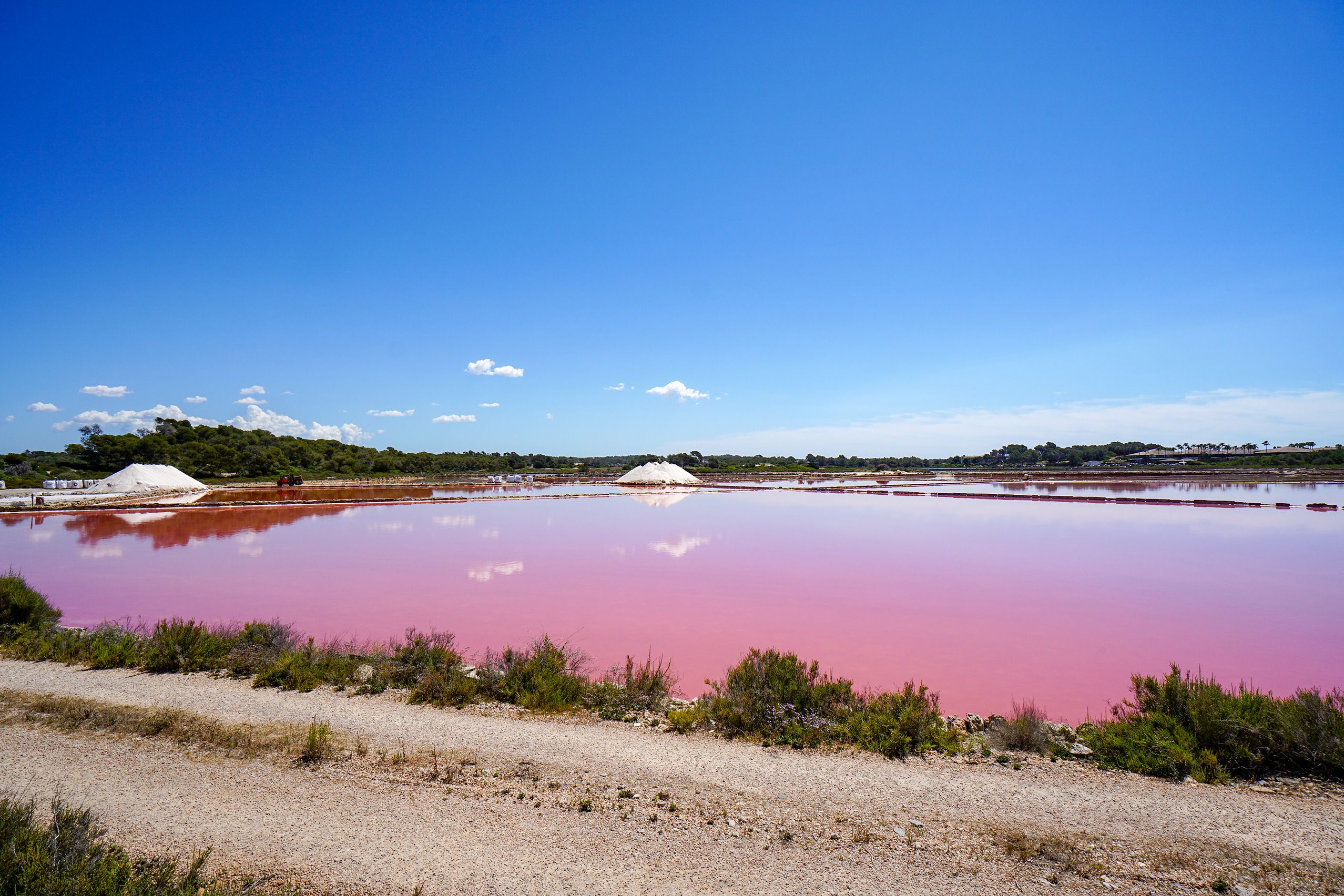
Around 170 hectares of salt pans between Campos and the coast produce roughly ten thousand tonnes of sea salt each year. The pools glow pink, flamingos wade nearby, and in summer tractors work among white heaps of salt.
Salines d'Es Trenc
Salines d'Es Trenc in 30 seconds
The essentials at a glance
- Worth visiting for
- A short visit
- Best for
- Taking a two-kilometre detour on the way to Es Trenc
- Best months
- March–October
- Time to allow
- An hour, or an hour and a half with a tour
- Without a car
- Hire car needed
- Parking
- Free parking at the saltworks
- Keep in mind
- Swimming, which is not possible here
- Access
- Pushchairs: Manageable on the main paths · Wheelchairs: Main paths are level but unsurfaced
Get a feel for Mallorca. Find your kind of place.
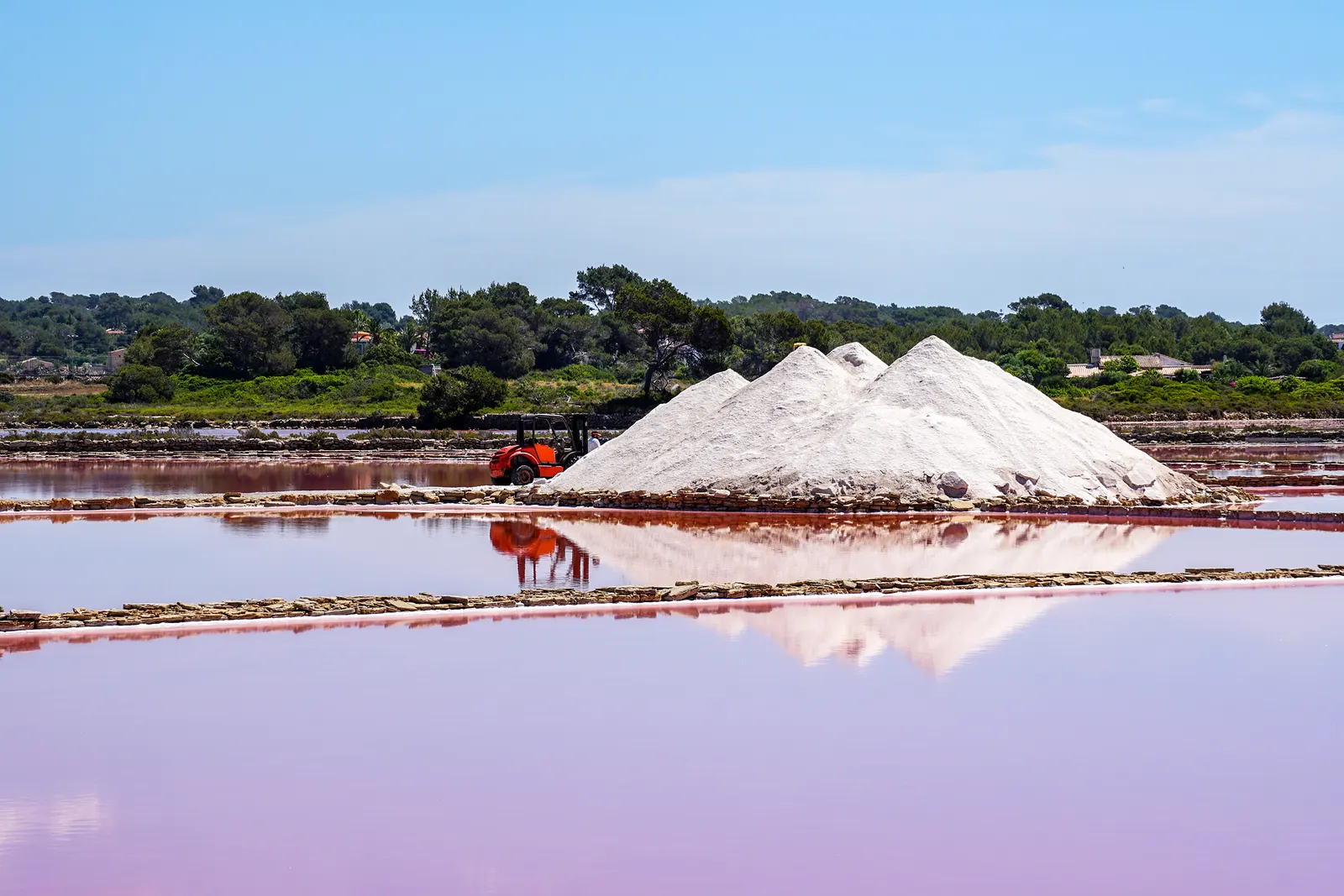
Roughly ten thousand tonnes a year, from 170 hectares of pools between Campos and the coast.
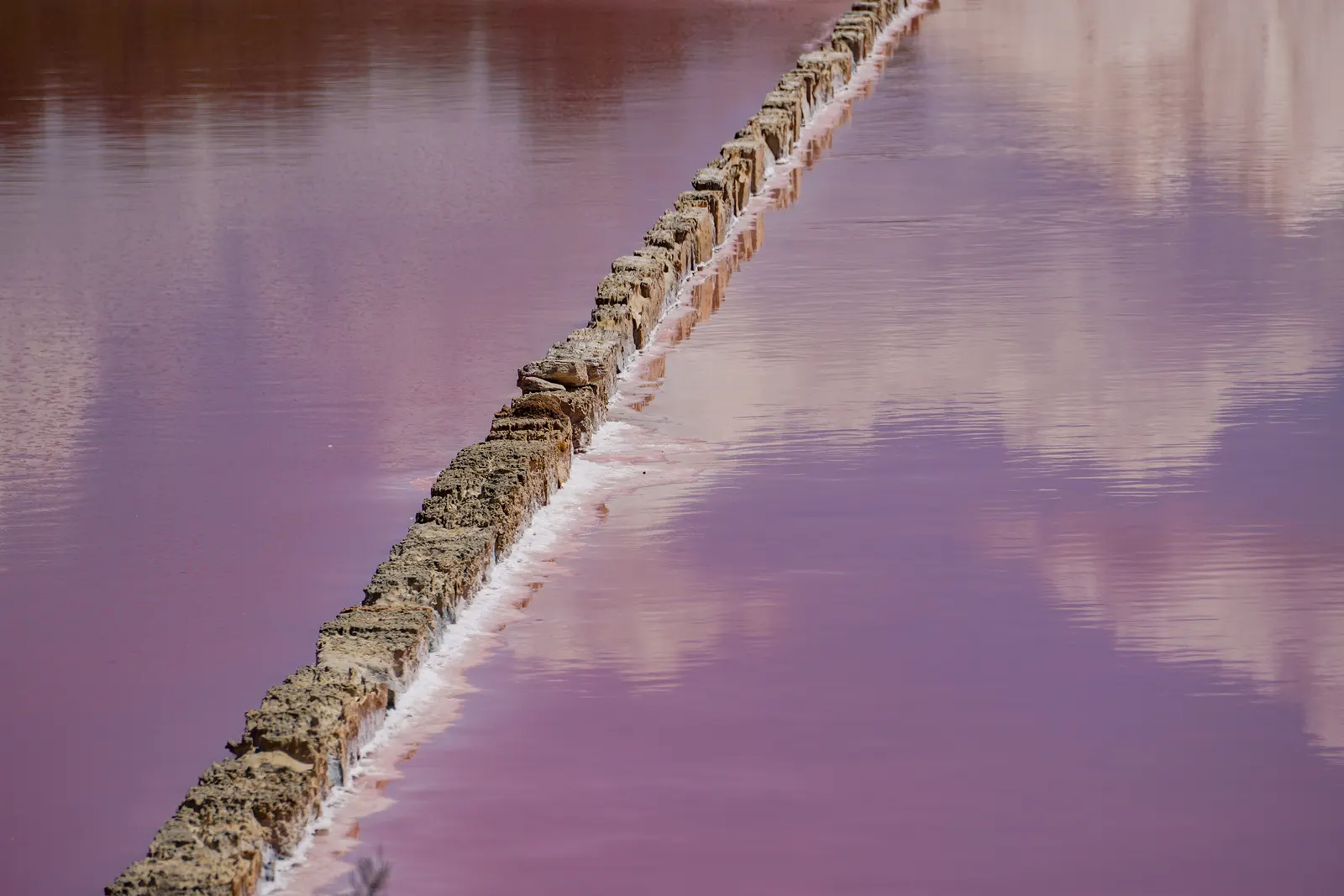
The banks separate the evaporation stages. The water gets saltier from pool to pool.
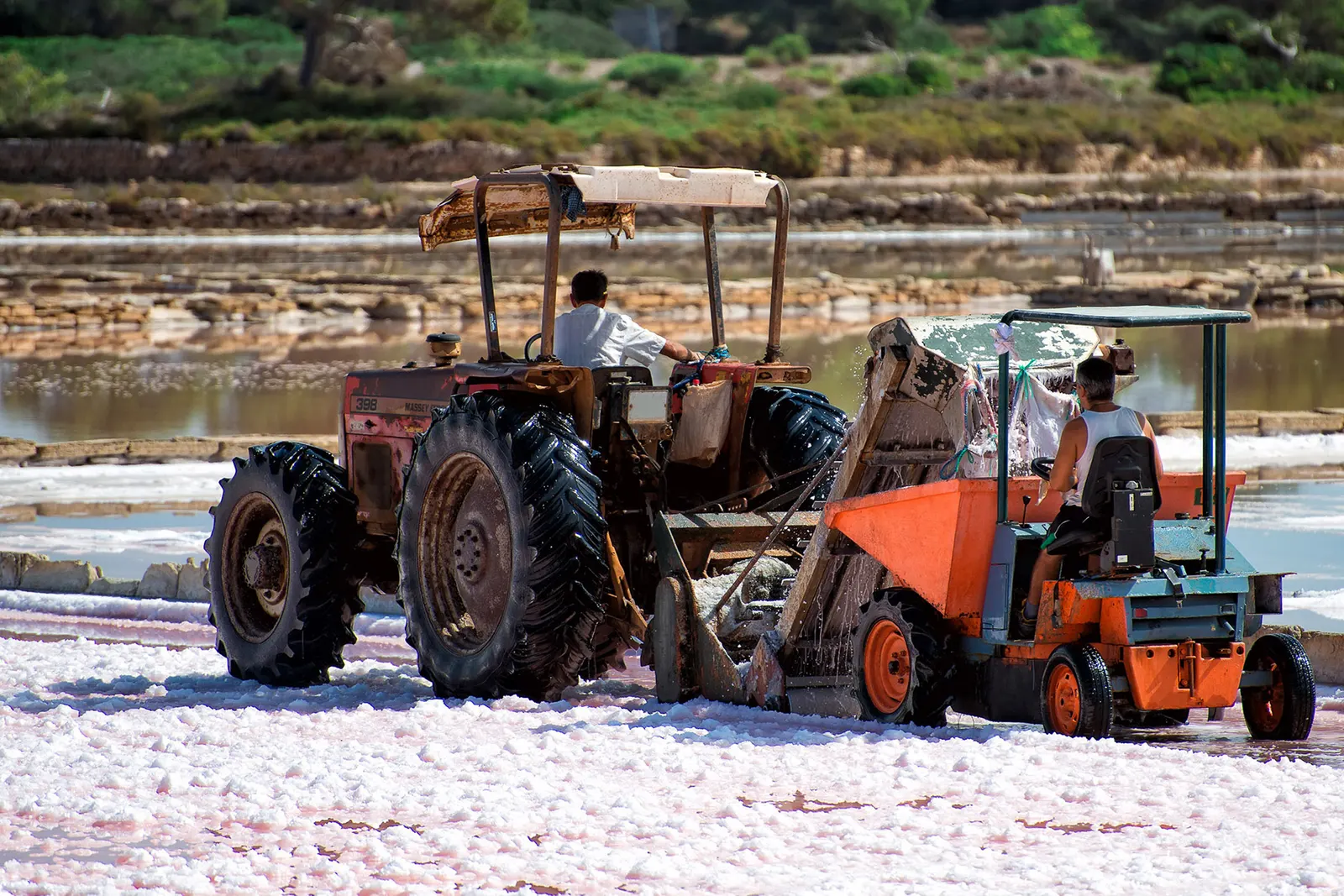
The harvest takes place in July and August. Flor de sal is skimmed from the surface by hand.
Getting to know Salines d'Es Trenc
Does Salines d'Es Trenc suit your plans?
What to expect and what to know before you visit.
Who it suits
- Taking a two-kilometre detour on the way to Es Trenc
- Birdwatching, with more than two hundred species recorded in the nature park
- Watching the summer salt harvest
- Joining a guided tour lasting about 45 minutes
Things to bear in mind
- Swimming, which is not possible here
- Needing shade, as the salt pans are completely exposed
- Expecting close views of flamingos without binoculars
- Hoping for the strongest colours in winter
Drive from the airport
38 minutes
38 km
Bus connections
No bus service
Region
Migjorn
Nearest beach
Es Trenc
1 km
Elevation
2 m
above sea level
Season guide for Salines d'Es Trenc
November Worth considering
Very quiet Some places closed
Worth visiting in March, April, May, June, July, August, September and October.
Location
Location of Salines d'Es Trenc
- Region
- Migjorn
- Municipality
- Campos
- Elevation
- 2 m above sea level
- Airport
- 38 km , around 38 minutes
- Hire car
- needed
- Worth visiting for
- a brief stop
- Coordinates
- 39.3439,2.9903
What are the Salines d’Es Trenc?
Around 170 hectares of salt pans between Campos and the coast, within Es Trenc-Salobrar de Campos nature park. They produce roughly ten thousand tonnes of sea salt each year.
The island’s most famous beach is two kilometres away, yet most people drive past without noticing the saltworks. From the road, you see only low banks and a few stretches of water. Park and walk a little further to discover the pink pools beyond.
Why the water is pink
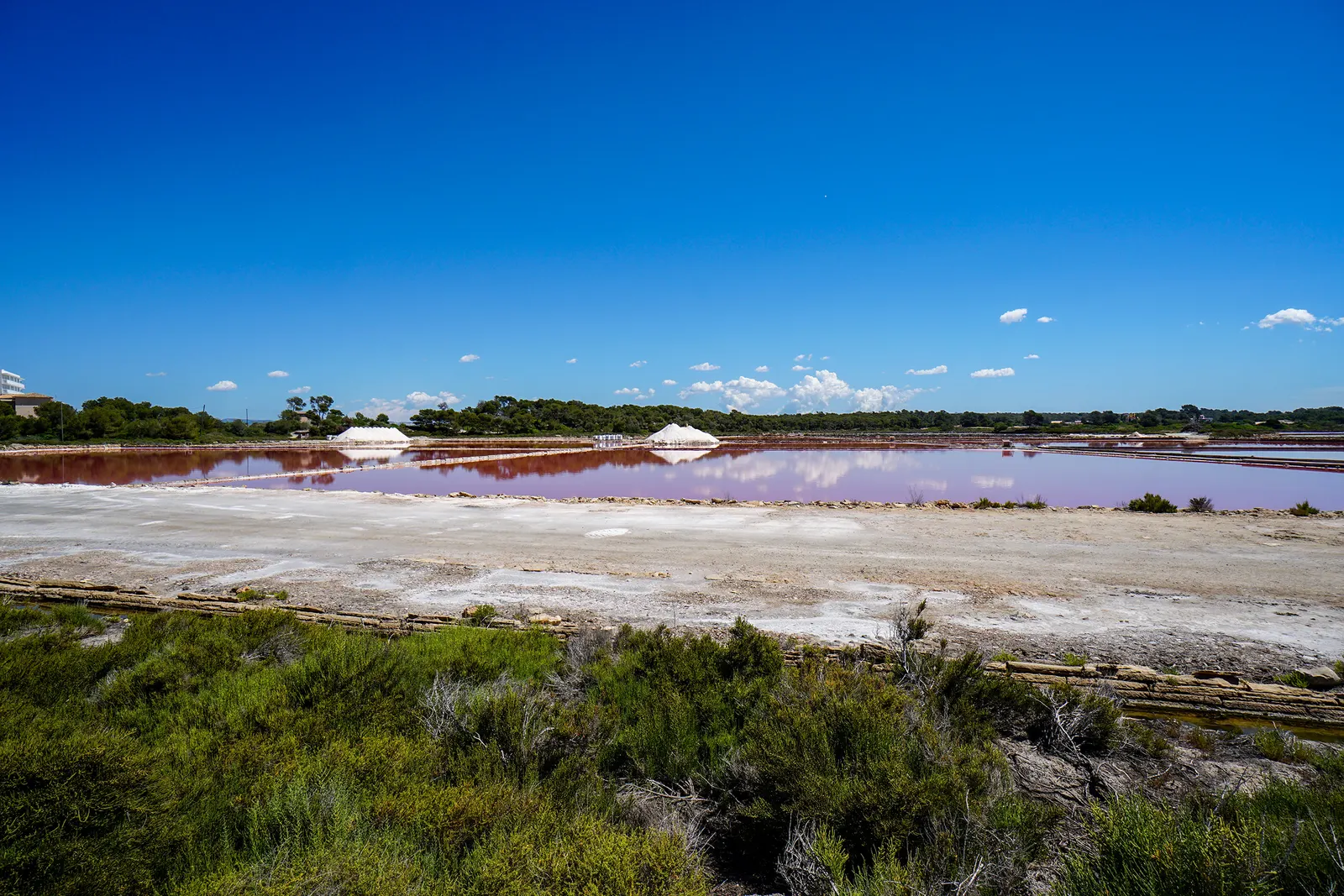
An alga living in extremely salty water produces a red pigment. The higher the salt concentration in a pool, the stronger its colour. The pink is an indicator of salinity.
The same alga feeds tiny crustaceans, which are eaten by flamingos. Their pink feathers get their colour from the same source.
The birds
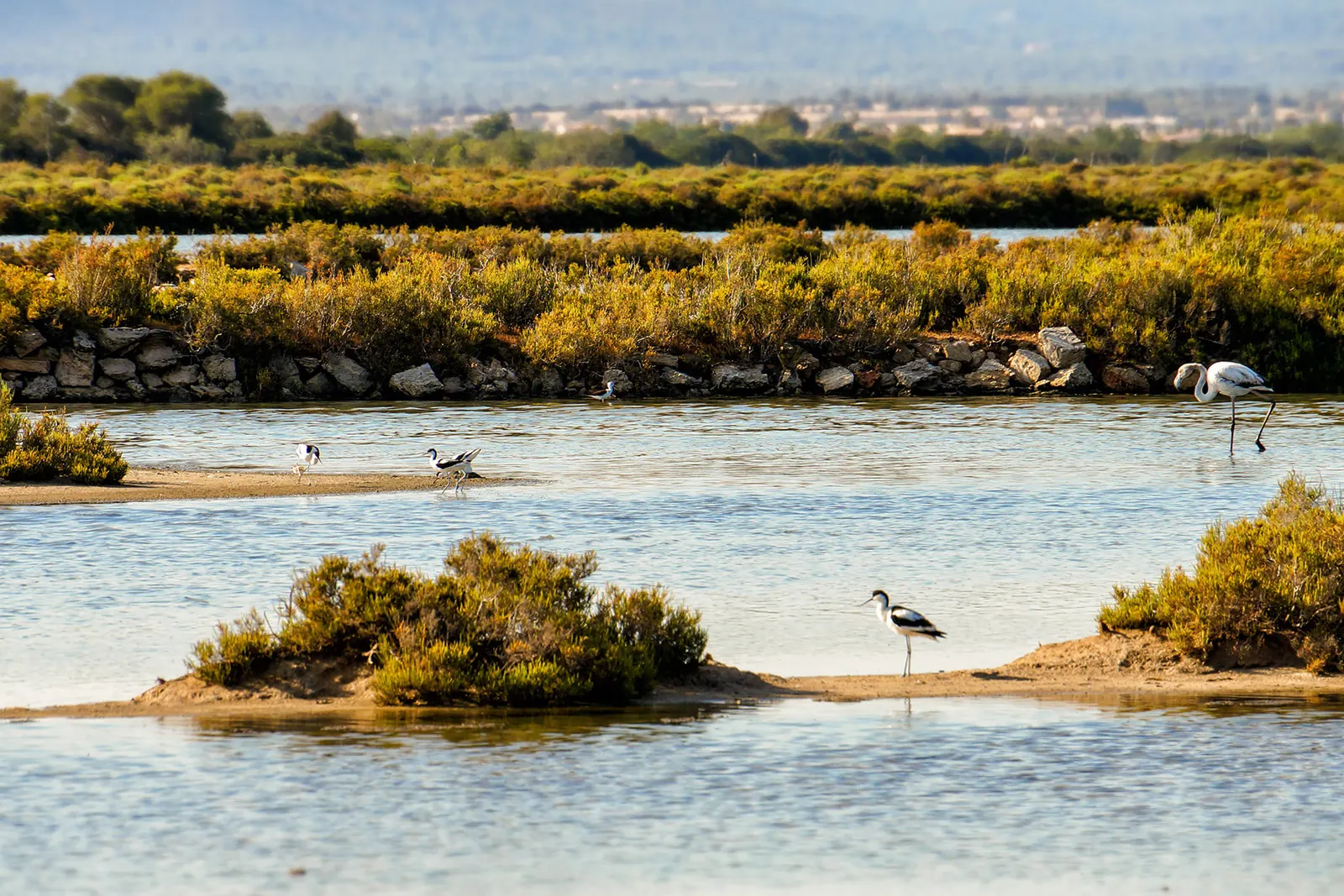
The Salobrar de Campos is one of the Balearics’ most important wetlands, with more than two hundred bird species recorded. Shallow salt pools are rich feeding grounds for waders, with plenty of food in the mud.
The busiest periods are spring and autumn, when birds stop here on migration between Europe and Africa. Flamingos, avocets, black-winged stilts and plovers can gather in their hundreds.
A tip from experience: bring binoculars. The birds stay well away from the paths. Without magnification, a flamingo may be little more than a pink dot in the distance. Binoculars make a real difference to a walk here.
How seawater becomes salt
The process is old and straightforward. Seawater is channelled into shallow pools and left to evaporate in the sun over several weeks. The brine becomes more concentrated as it passes from pool to pool — which also explains the changing colour — until salt crystallises.
The harvest takes place in July and August. Machines push salt from the bottom of the pools into white heaps, which stand beside them for days while they drain. This is when the saltworks look most impressive.
One variety is still harvested by hand: flor de sal, the fine crust that forms on the water’s surface in calm weather. Workers skim it with flat scoops before it sinks, which helps explain the price.
For a closer look at the process, join a guided tour. It takes around 45 minutes, following the water’s journey from the first pool to the finished bag of salt.
When to visit
September is the best month. The salt heaps remain, the colours are strong and visitor numbers ease. October comes a close second for the warm light across the pools.
In March and April, migrating birds stop here — the best time of year if you bring binoculars.
In winter, the pools are full of water and their colours are pale. In high summer, there is no shade or drinking water out among the pools. Late afternoon is better than midday, and the colours are deeper then too.
Photographs
Salines d'Es Trenc in Mallorca
How much time do you have?
Things to do in Salines d'Es Trenc
Three hours
Walk beside the pools, look for flamingos and black-winged stilts with binoculars, then try the different salts in the shop.
Half a day
Combine it with Es Trenc or Sa Ràpita, both around ten minutes away.
A full day
Add Campos, Ses Salines and the south coast for a full day out.
On a rainy day
Not much to do. The pools are exposed and lose their colour in the rain.
Practical details
- Parking
- Free parking at the saltworks
- Time to allow
- An hour, or an hour and a half with a tour
- Good to know
- Guided visits take around 45 minutes and explain how seawater becomes salt. Without a tour, you can see the pools from the paths. Bring binoculars, as the birds keep their distance.
- Bus
- No bus service
- Access
- Flat gravel and dirt paths between the pools · Pushchairs: Manageable on the main paths · Wheelchairs: Main paths are level but unsurfaced · Dogs: Keep on a lead and take care not to disturb birds
- What you will not find
- A place to swim · Shade · A bus service · Strong colours in winter
- Coordinates
- 39.3439,2.9903 Google Maps Apple Maps
Within reach
Places to visit
Nearby

Mallorca’s southernmost point has a lighthouse built in 1863, flat coastal rocks and open sea, with the …

A freestanding rock arch in the sea, one of the south-east coast’s best-known views. The viewpoint lies between …

A Talayotic settlement beside the south-coast road, with five massive dry-stone towers and the outlines of …

A small 15th-century sanctuary on a 205-metre hill near S'Alqueria Blanca, rarely busy and with views over the …
Distances without a driving time are measured in a straight line. The road journey can be much longer; known driving times are shown alongside.
Where to swim nearby
Beaches and swimming nearby

Pale sand, dunes and turquoise water: Es Trenc lies on Mallorca’s south coast between Ses Covetes and Colònia de …

A small coastal settlement at the western end of Es Trenc, giving access to the natural beach. The unfinished …

A former fishing harbour in southern Mallorca, now a holiday resort with several beaches close by. Boats leave for …

A strip of white sand between Colònia de Sant Jordi and Mallorca's southern tip, reached on foot or by boat. The …
Places to stay within reach
Explore from here
Your questions answered
Your questions about Salines d'Es Trenc
Why is the water pink?
An alga living in extremely salty water produces a red pigment. The higher the salt concentration, the stronger the colour. The same alga feeds tiny crustaceans eaten by flamingos, whose pink feathers owe their colour to the same source.
When can you see flamingos?
Throughout the year, but most reliably during spring and autumn migration. Es Trenc-Salobrar de Campos nature park is one of the Balearics' most important wetlands, with more than two hundred bird species recorded. Bring binoculars, as the birds keep their distance.
When is the salt harvested?
In summer, mainly July and August. Machines push crystallised salt into white heaps. Flor de sal, which forms on the water's surface, is skimmed off by hand.
Can you visit the salt pans?
Yes. Guided visits last around 45 minutes and explain the journey from seawater to finished salt. Without a tour, you can see the pools from the paths. Swimming is not allowed here; Es Trenc beach is two kilometres away.
How much salt is produced here?
Around ten thousand tonnes a year across roughly 170 hectares. It is exported to more than a dozen countries, and the flor de sal is highly regarded among sea salts.
Practical questions
When is the best time to visit Salines d'Es Trenc?
Recommended months: March, April, May, June, July, August, September, October. Migrating birds stop in the Salobrar — the best time of year if you bring binoculars.
Is Salines d'Es Trenc worth visiting in July and August?
July: worth a visit. Usually lively. Harvest time, with the brightest colours and machinery at work. August: worth a visit. Usually lively. Like July, but the lack of shade makes it tough unless you bring drinking water.
How far is Salines d'Es Trenc from Palma airport?
About 38 km from Palma airport. Allow roughly 38 minutes by car. On the road from Campos towards Colònia de Sant Jordi, around ten kilometres south of Campos. The entrance is signposted, with parking at the saltworks.
Do I need a hire car for Salines d'Es Trenc?
A car is needed No bus service
Where can I park in Salines d'Es Trenc?
Free parking at the saltworks
Can I visit Salines d'Es Trenc with a pushchair or wheelchair?
Flat gravel and dirt paths between the pools Pushchairs: Manageable on the main paths Wheelchairs: Main paths are level but unsurfaced
Are dogs allowed at Salines d'Es Trenc?
Keep on a lead and take care not to disturb birds
Words and photographs: Friedhelm Fischer. Exploring Mallorca since 2013 — by bike, on foot and with a camera.