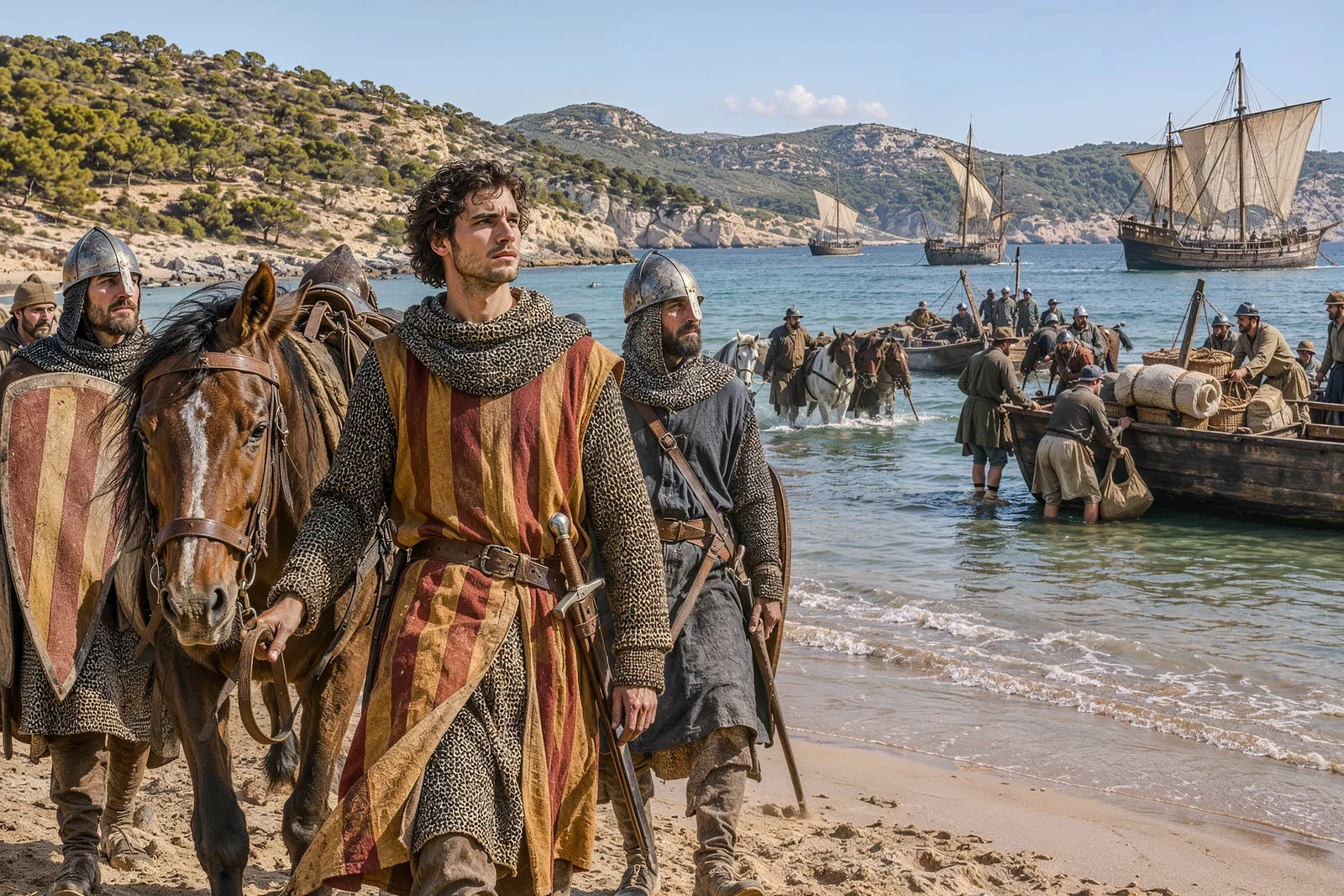
The conquest of Mallorca in 1229
The landing at Santa Ponça in September 1229
Jaume I landed at Santa Ponça before his troops stormed the capital. What followed changed life across the island. Discover how Mallorca was conquered, what happened to its people and which buildings tell the story of the following centuries.
The king and his army
Who was Jaume I?
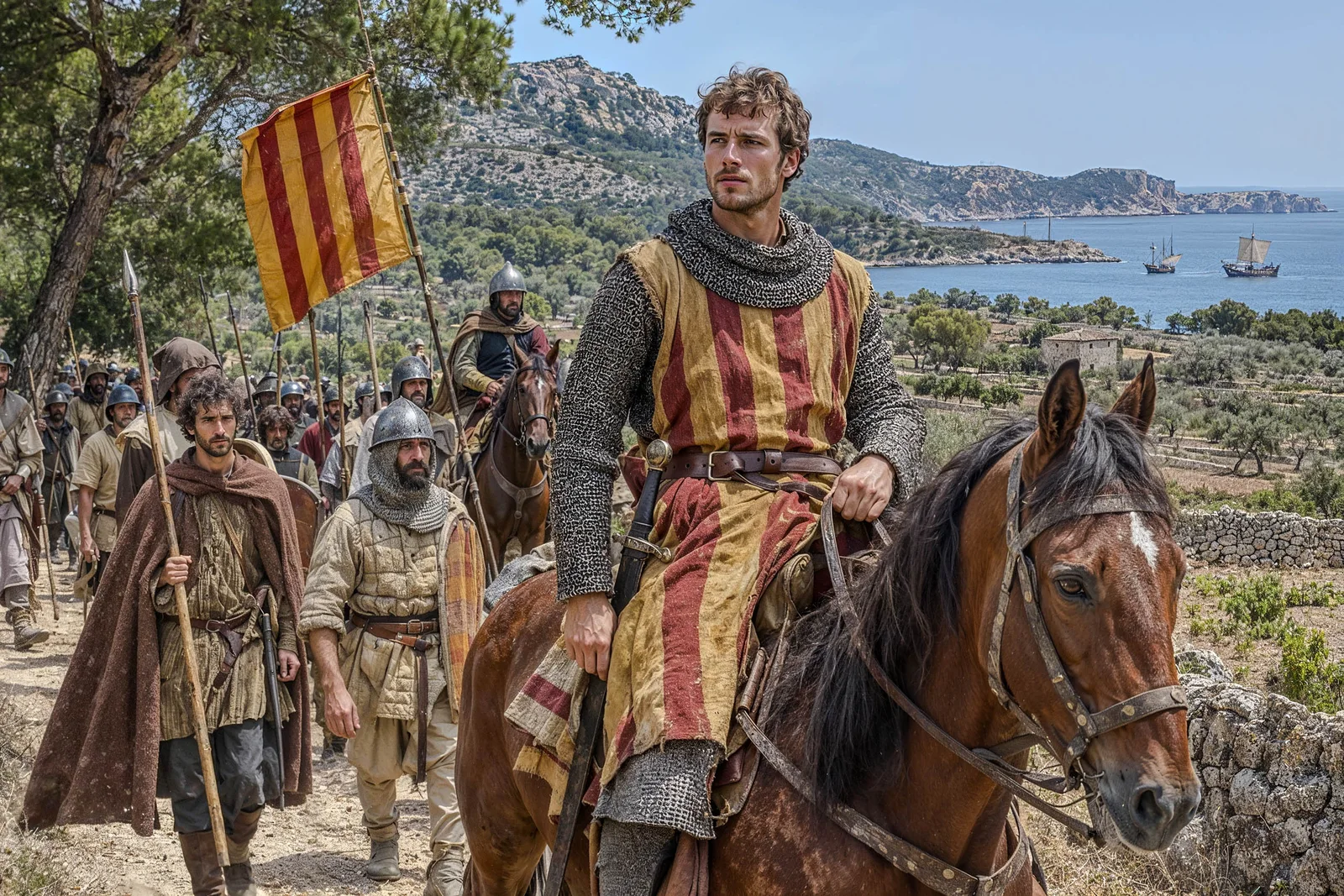
Jaume I was King of Aragón and Count of Barcelona. In English he is James I, in Spanish Jaime I, and his byname is “the Conqueror”. In 1229, he led the army that attacked Muslim-ruled Mallorca.
His crown comprised several territories. There was no Spanish nation-state in the modern sense. References to the “Spanish conquest” of Mallorca usually mean this campaign, although the conquest by Jaume I and his army is more precise. Many of his men came from Catalan territories.
The island already had an established society of towns, villages, farms and trading connections. Read about it in Muslim Mallorca.
 AI
Land, power and sea routes
Why did Jaume I want Mallorca?
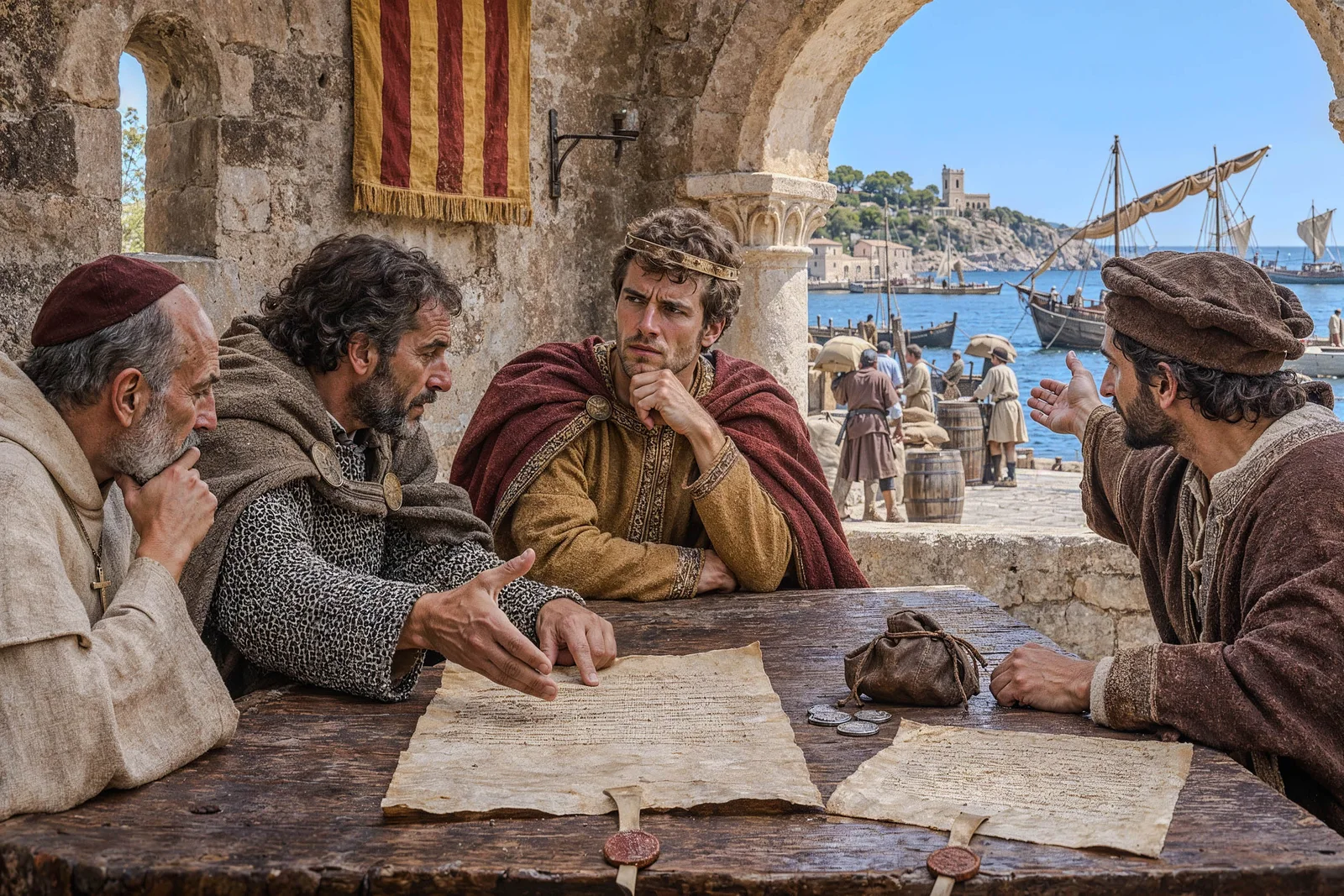
For the king, Mallorca promised territory and revenue. Noblemen and church supporters expected land, houses, income and spoils. Claims to property were agreed before the campaign had succeeded.
The island's position in the western Mediterranean mattered too. Controlling Mallorca brought influence over sea routes between the Iberian Peninsula, North Africa and Italy. The war also received religious justification and papal support. Political ambition, economic aims and Christian zeal were closely connected for those involved.
 AI
10 September 1229
The landing at Santa Ponça
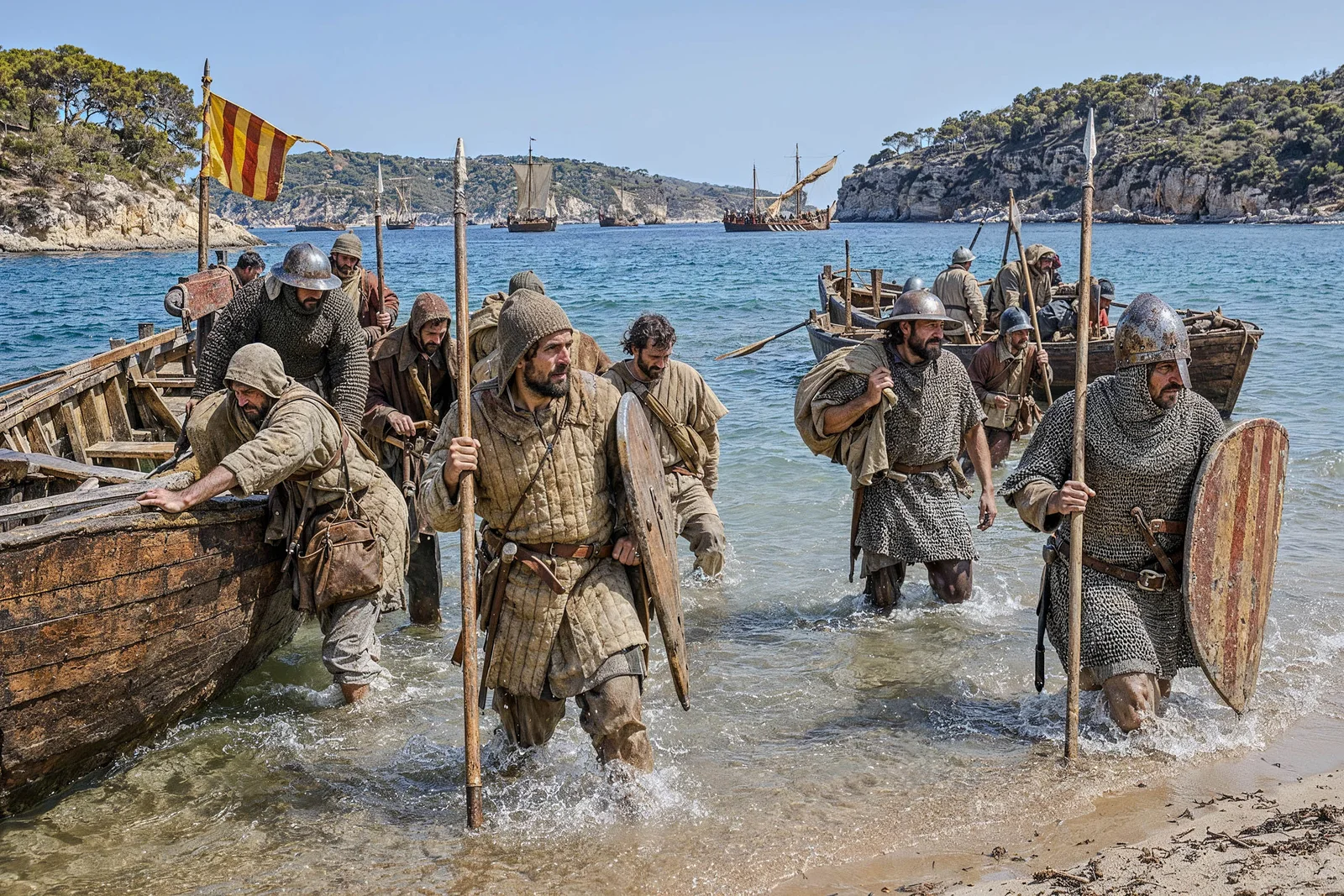
The fleet sailed from the Catalan coast. On 10 September 1229, troops landed at Santa Ponça, making today's holiday resort the starting point for the advance on the capital.
Fighting followed along the route, including the Battle of Portopí on 12 September. The army then began besieging Madina Mayurqa, present-day Palma.
A cross at Santa Ponça commemorates the landing. It is a later monument, not a surviving part of the king's camp. The Festes del rei En Jaume also mark the events, with celebrations and re-enactments around the anniversary.
 AI
31 December 1229
The capture of Madina Mayurqa
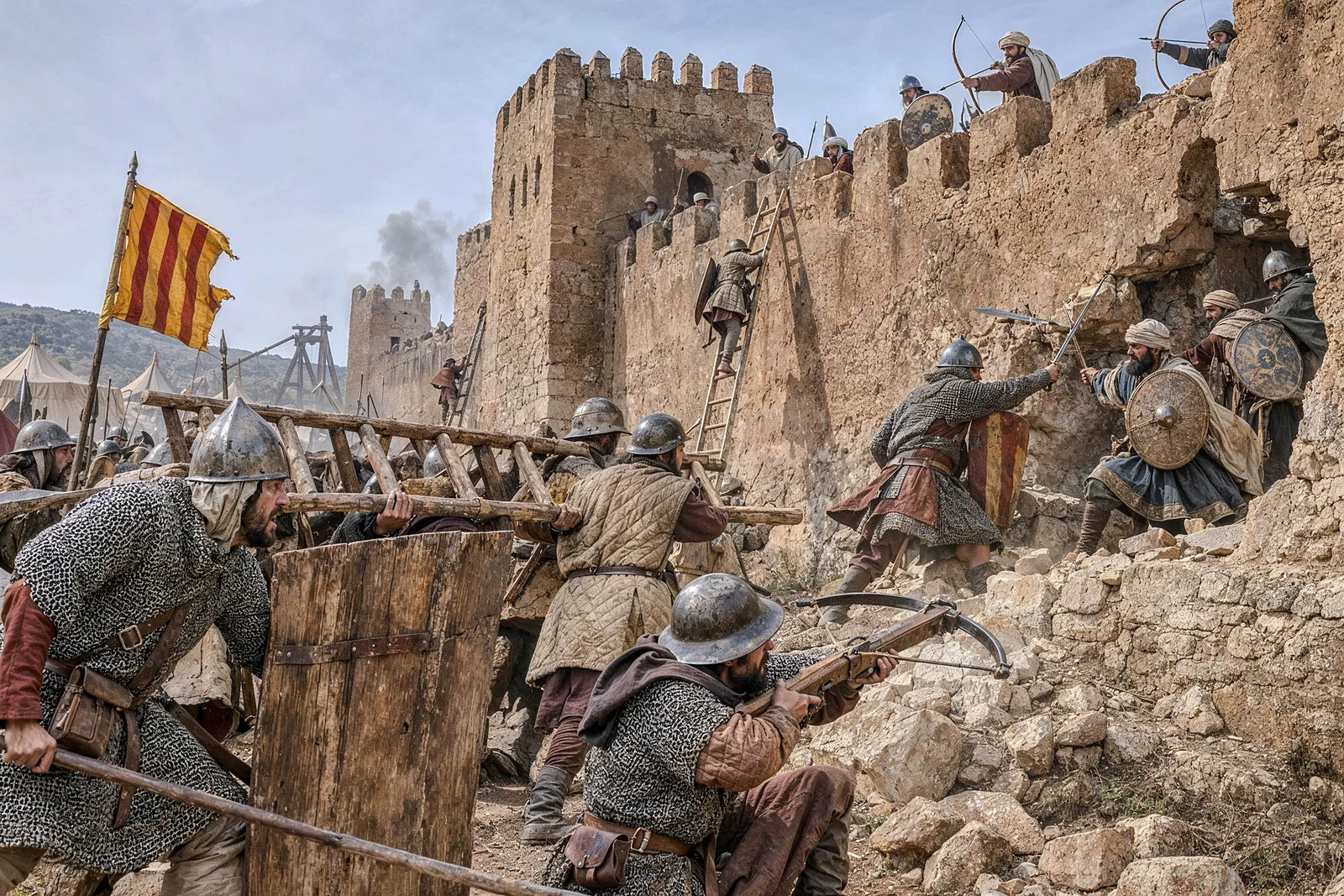
The siege lasted several months. On 31 December 1229, the troops entered the capital. Looting and widespread violence followed.
Residents were killed, captured and enslaved; others escaped inland. For the Muslim population, Jaume I's victory meant the collapse of their political order and, for many, the loss of family, freedom and property.
The campaign did not end with the capital's fall. Focusing only on 1229 leaves out the fighting that continued in the mountains.
 AI
1230–1232
Flight and resistance in the Tramuntana
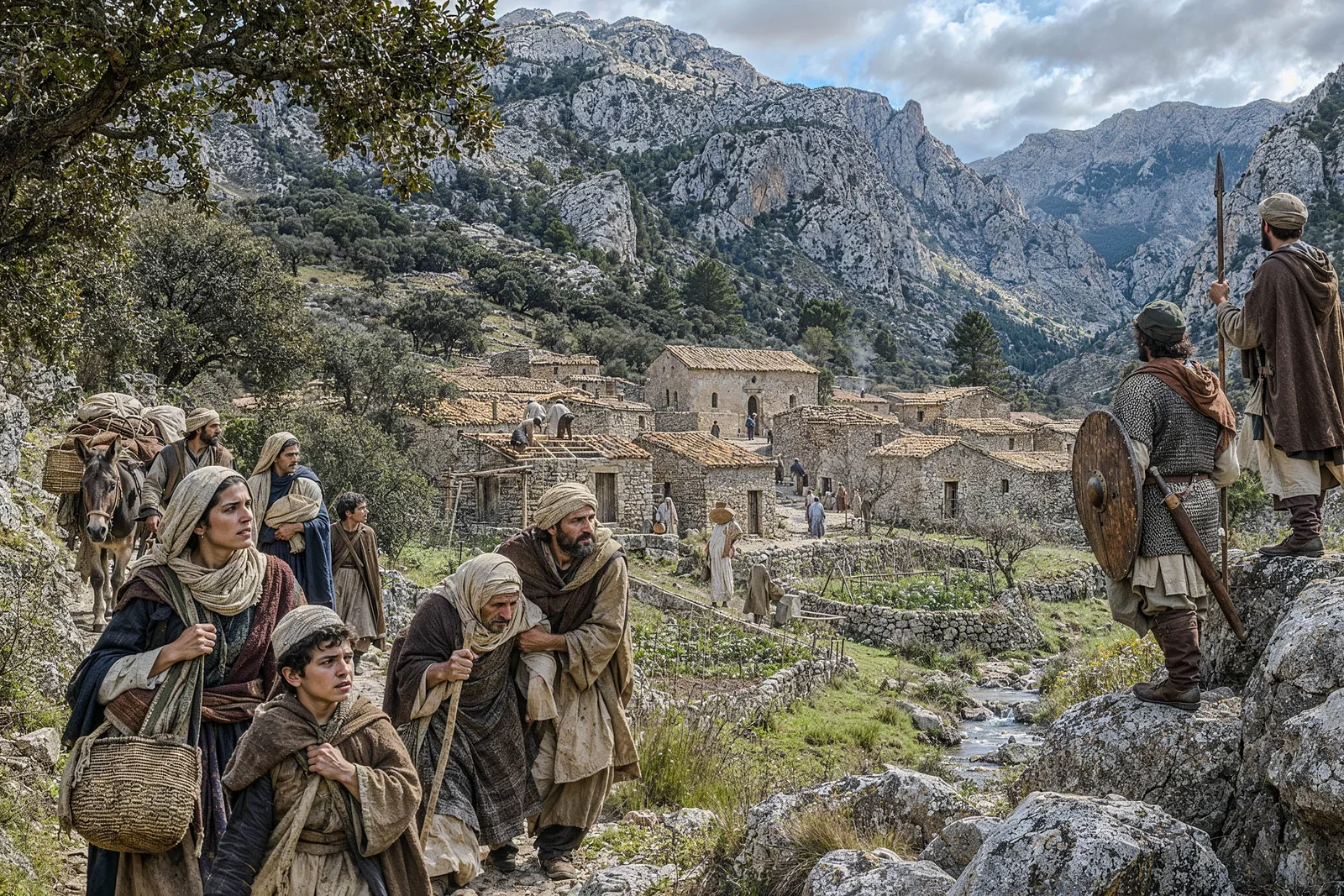
Muslim residents sought protection in the Serra de Tramuntana, including the areas around Sóller and Banyalbufar, and Almallutx beside today's Gorg Blau reservoir.
At Almallutx, archaeologists have studied houses, a mosque and a cemetery. Together with written accounts, these finds reveal something of the people living in the mountains after Palma fell. Fighting, negotiation and submission continued until 1232.
Almallutx now lies in the reservoir's flood zone and is not a regularly accessible open-air museum. Read more in the Almallutx section.
 AI
Life after the war
What happened to the Muslim population?
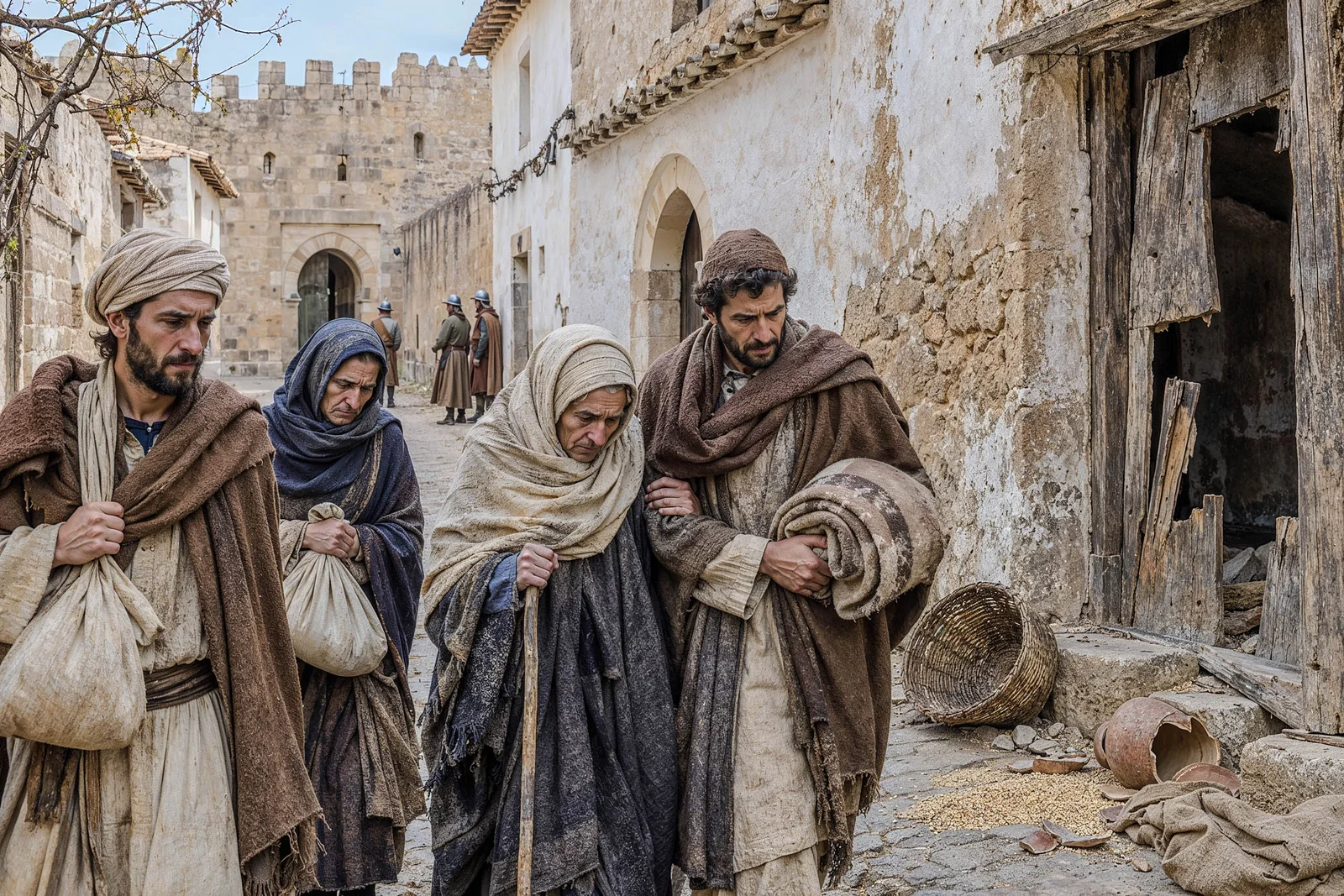
Many survivors were enslaved and sold, working on farms, in urban households and in businesses. Slavery did not end with the fighting; it remained part of the economy for a long time.
Others fled, gained their freedom or continued as free Muslims under specific legal conditions. Ransoms and overseas connections could change individual lives. The Muslim population did not disappear from the island overnight.
Even so, the consequences were fundamental for much of the population. New rulers took over land and houses, while former owners lost rights and their means of making a living.
 AI
The Repartiment
The victors divide the island
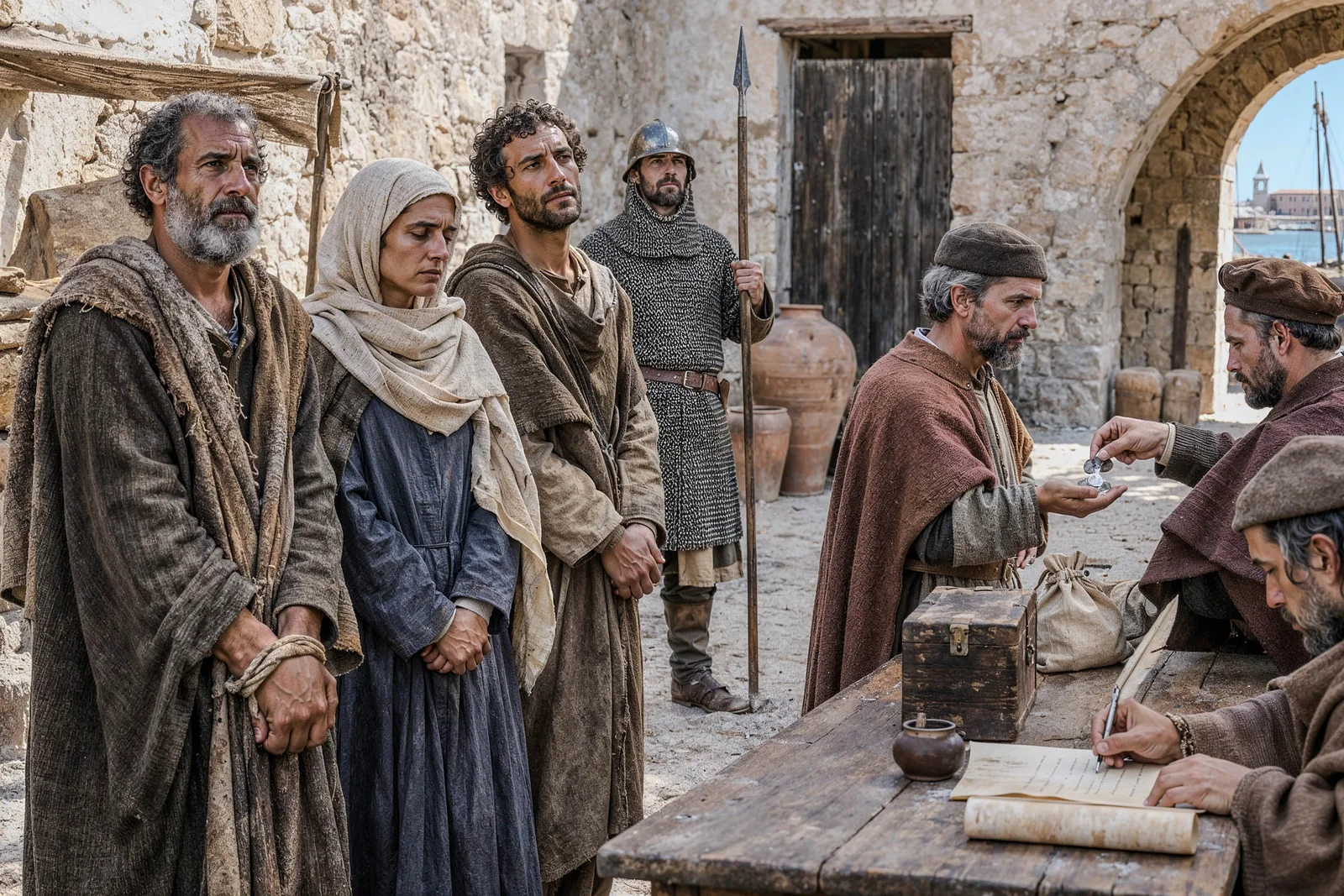
Land, houses and revenues were shared among the victors. Roughly half went to the king, with the rest assigned to major supporters of the campaign, who redistributed their shares. This division is known as the Repartiment.
The Llibre del Repartiment records property and new claims, making it an important source for settlement and land use. For previous owners, redistribution usually meant dispossession.
Jaume I took the title King of Mallorca after capturing the capital. The kingdom therefore did not begin only with the inheritance division of 1276. The Carta de Franqueses of 1 March 1230 set out rights for the new population, covering property, justice and trade. Privileges were intended to attract settlers and revive economic activity.
 AI
New settlers and churches
Why Catalan is spoken on Mallorca
Many settlers came from Catalan territories. Their arrival laid an important foundation for Catalan on Mallorca. Language changed over generations, rather than every resident switching on a single day.
Mallorcan belongs to the varieties of Catalan spoken in the Balearic Islands. Its history is closely linked to settlement after the conquest.
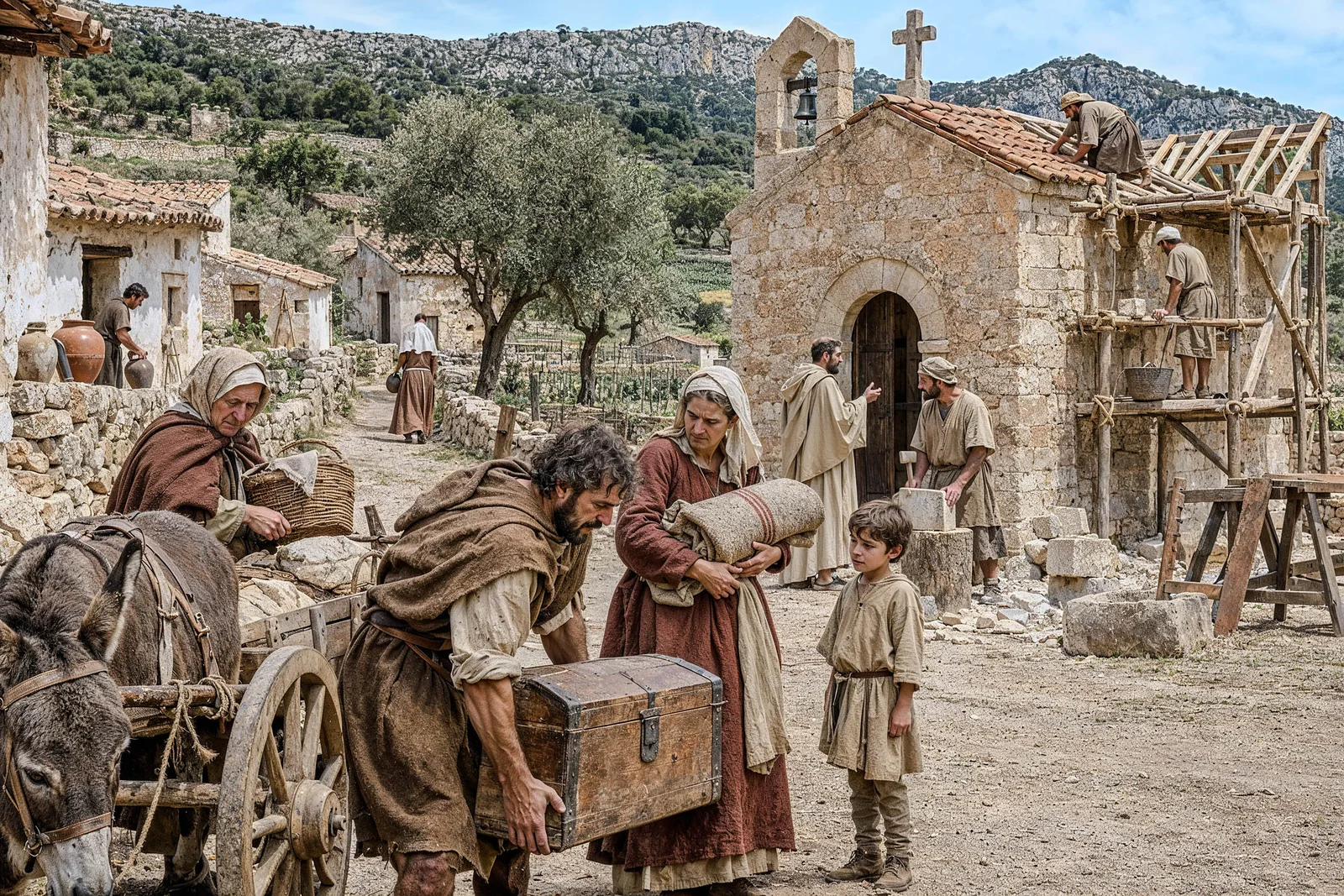
The rulers' religion and public institutions changed too. Churches and monasteries were founded, and the Christian Church acquired property and influence. Muslim minorities and Jewish communities also remained part of the island's history.
 AI
La Seu in Palma
From main mosque to Christian church
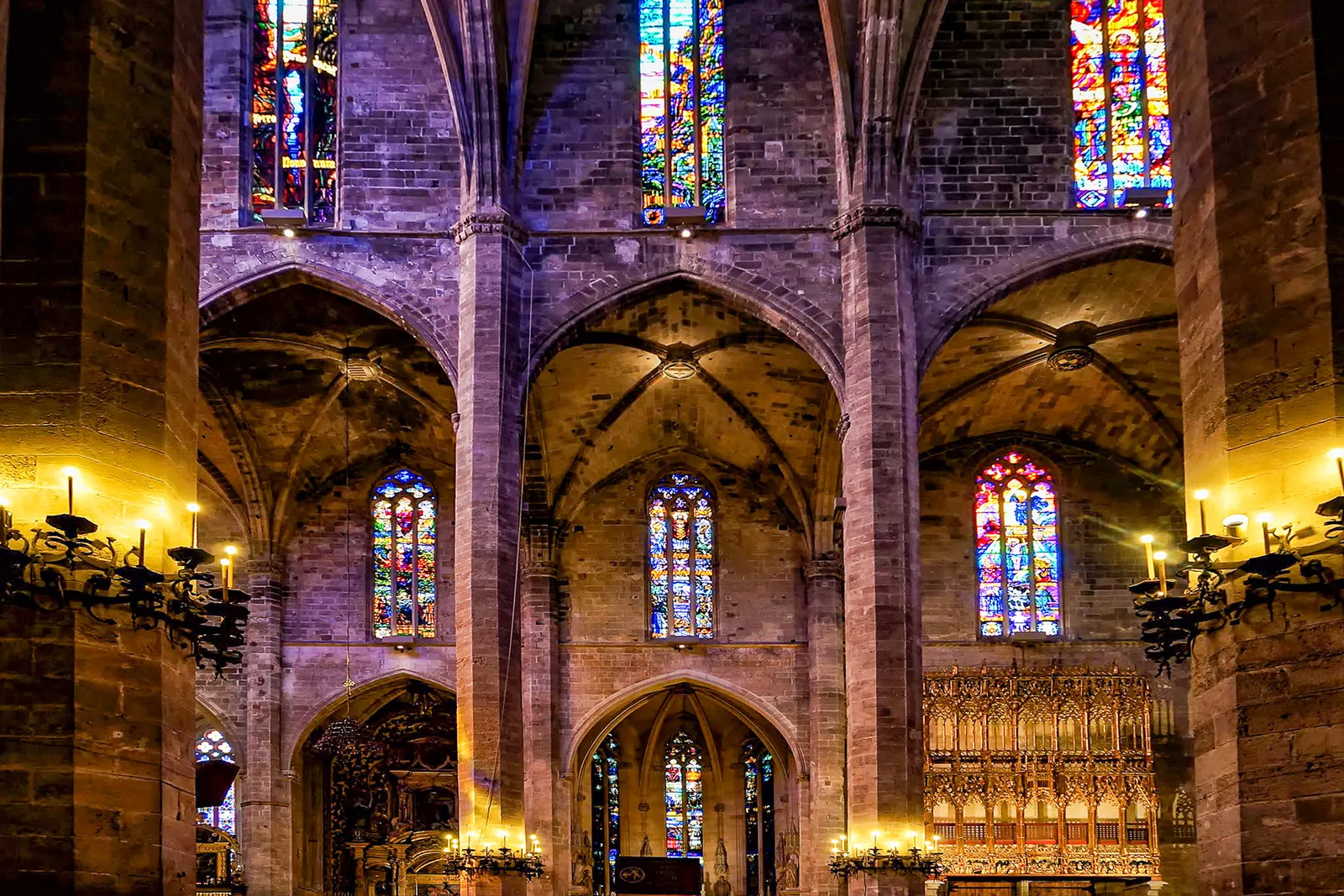
After the conquest, Palma's main mosque was consecrated for Christian worship. The great La Seu cathedral you see beside the sea today did not yet exist.
Construction began in the 13th century and continued across many generations. The official building history extends into the 1630s, followed by further alterations. Today's cathedral belongs to the conquest's long-term consequences, not the skyline of 1229.
Inside, you also see work from much later periods, including Antoni Gaudí's changes in the early 20th century.
Building for the royal family
The Almudaina and Bellver
The Almudaina, opposite the cathedral, had already served as an Islamic residence. Under Jaume II in the early 14th century, it was extensively remodelled as a royal palace, with a major building phase between 1305 and 1314.
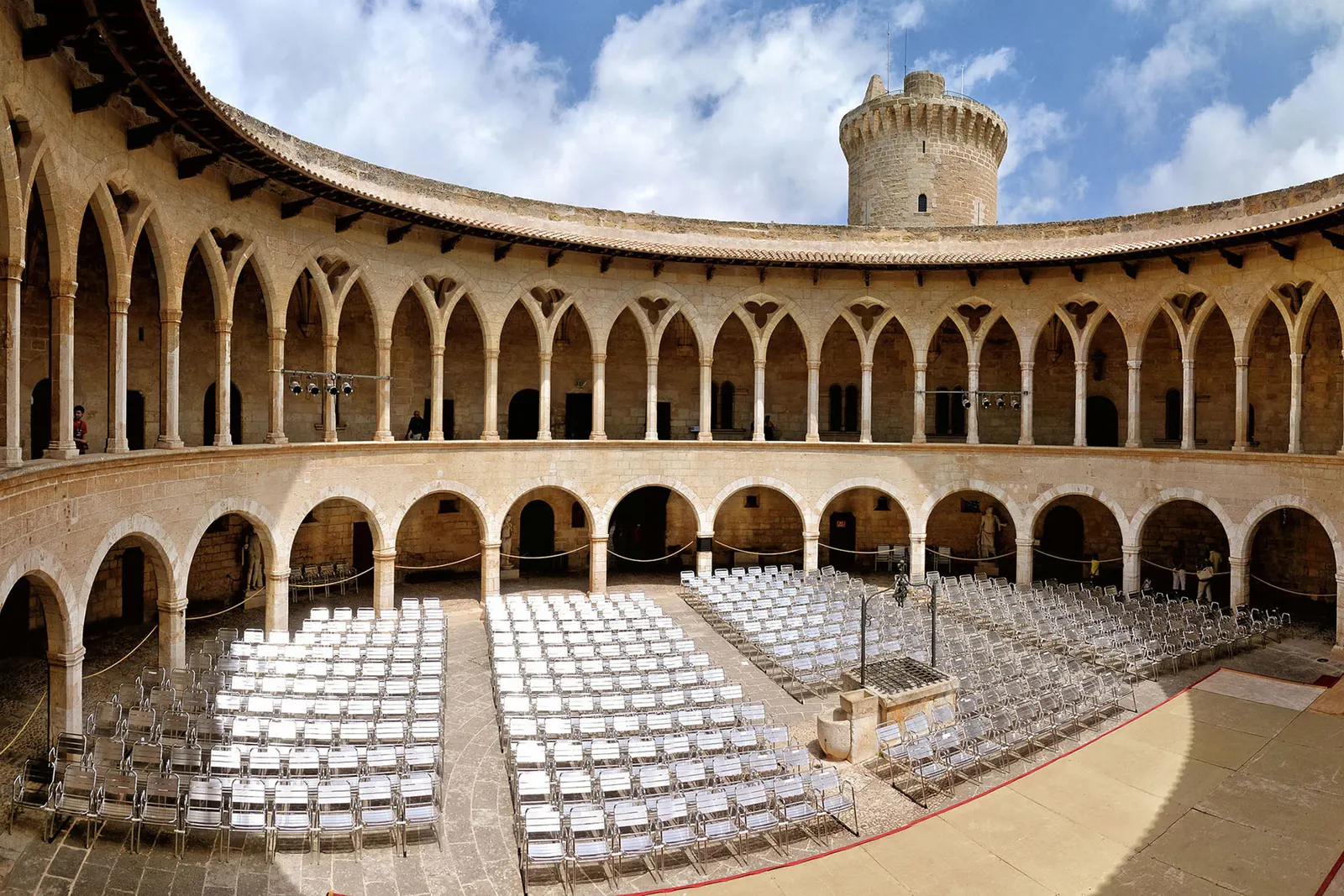
Castell de Bellver belongs to this later period too. Jaume II had the round castle built between 1300 and 1311 on a wooded hill above Palma, intended as a royal residence.
You can visit both. The Almudaina is beside La Seu, while Bellver needs a separate detour. Its circular courtyard and views across the bay give a sense of the ambition behind these royal buildings.
1276–1349
A separate royal house — and more wars
After Jaume I died in 1276, his son Jaume II inherited Mallorca and other possessions, including territories north of the Pyrenees. His realm was therefore larger than the island alone. In 1279, he had to recognise the overlordship of the Aragonese branch of the family.
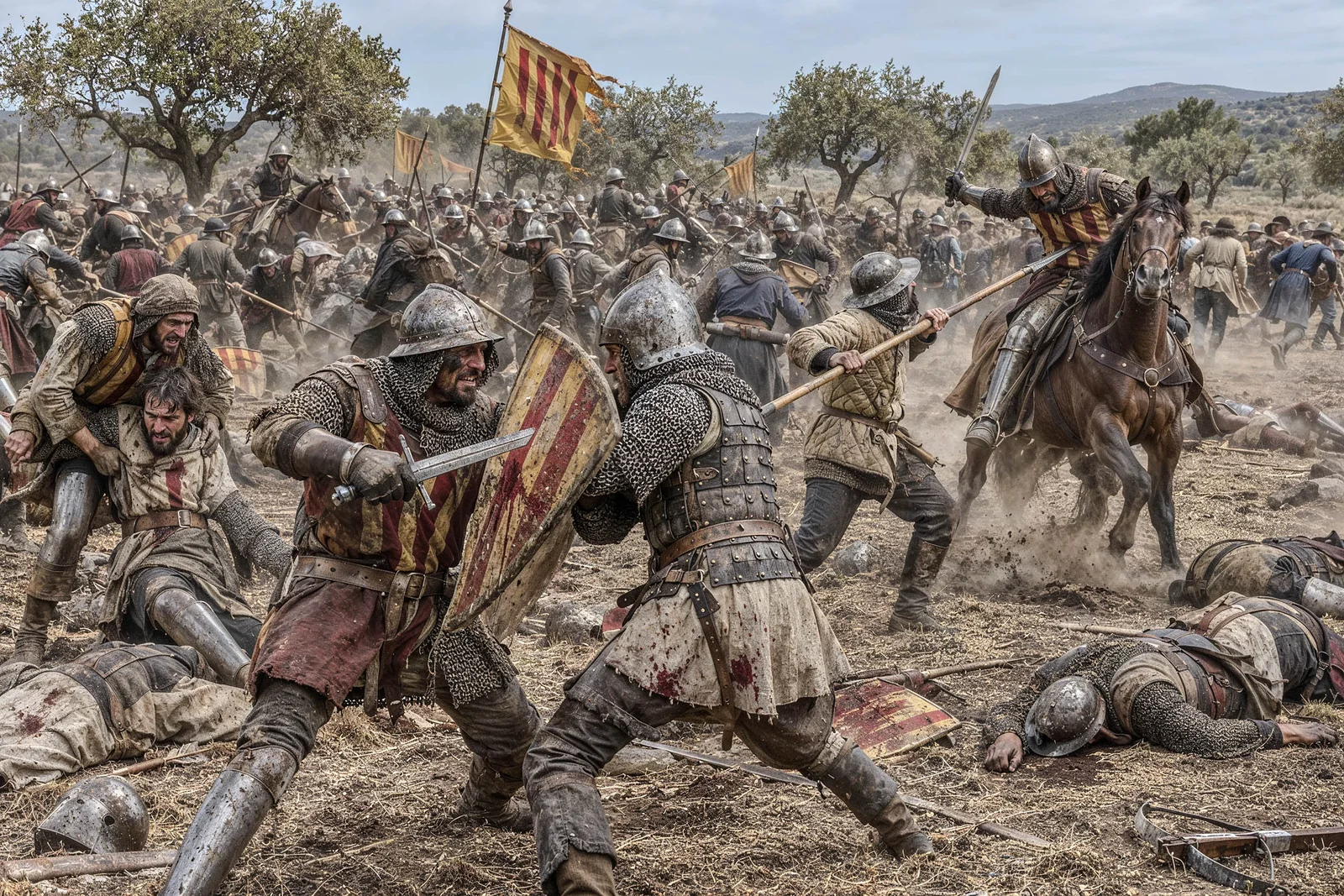
Relations remained troubled. The Aragonese branch occupied Mallorca in 1285. In 1343, Pere IV seized it from Jaume III, whose attempt to recover the island ended in defeat and death at Llucmajor in 1349.
The separate royal house failed, but the title “Kingdom of Mallorca” and distinct institutions continued. The takeover of 1343 and the battle of 1349 were two different events.
 AI
Fields, estates and labour
What survived, and what changed later
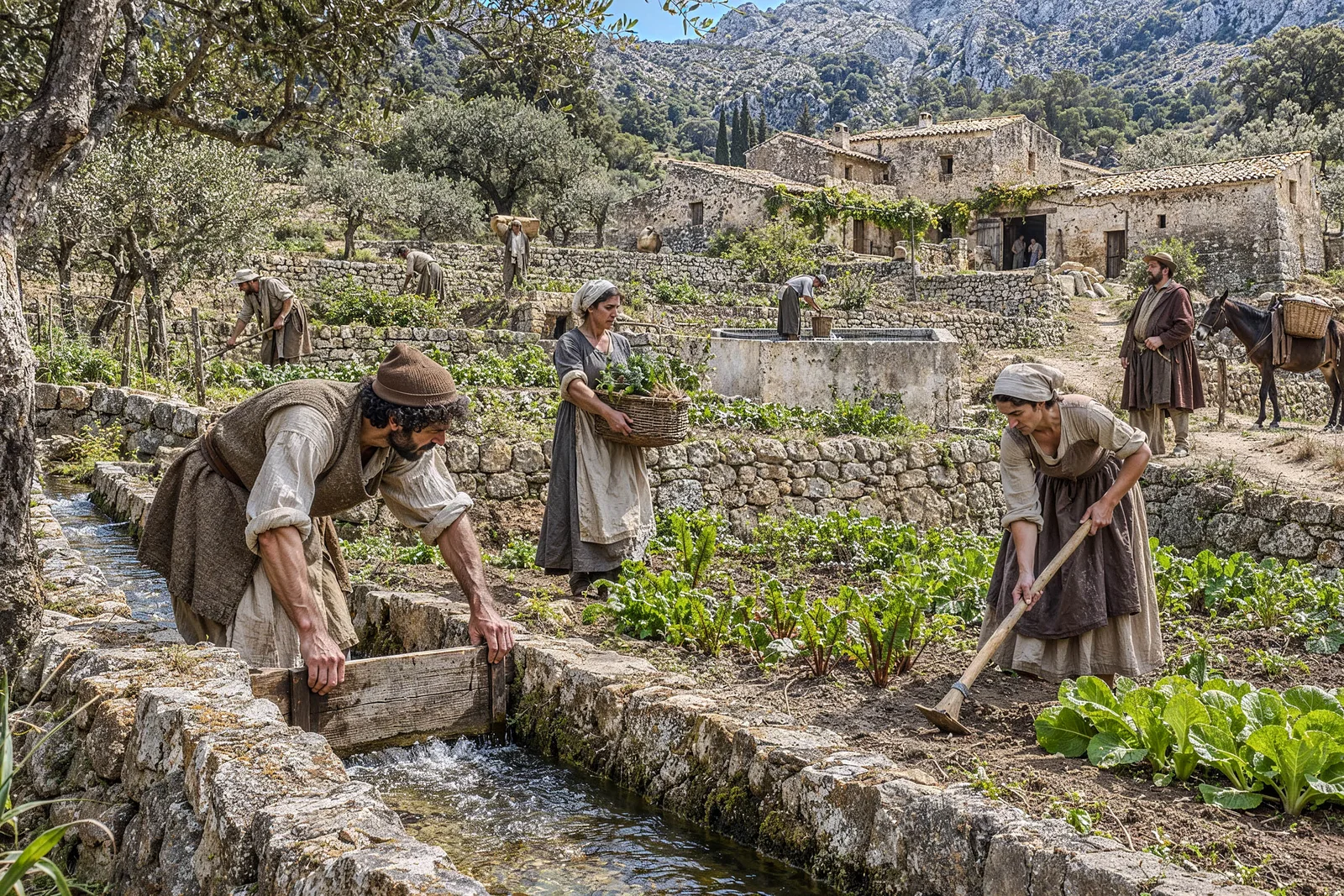
New landowners continued using existing springs, channels, storage pools and farmland. In the Tramuntana, older water systems were combined with later terraces, dry-stone structures and larger estates. The walls you see today do not all belong to one period.
Mallorca's large estates, the possessions, took their familiar form through a long process. Land was sold, combined or lost through debt. Enslaved people were still working on large estates in the 14th and first half of the 15th centuries.
Later, taxes and tensions between town and countryside led to new conflicts, including the Revolta Forana from 1450 and the Germanies from 1521. These were not continuations of Muslim resistance in 1229, but rebellions within a society that had changed fundamentally.
For the story from 1700 onwards, return to our history overview.
 AI
History on your travels
Places connected with the conquest and its aftermath
Santa Ponça’s cross commemorates the landing. La Seu grew after the main mosque was converted to Christian worship, while the Almudaina was extensively rebuilt as a royal residence. Bellver’s round castle belongs to Jaume II’s early 14th-century building programme.

The landing of 1229
Santa Ponça
The cross in today’s holiday resort commemorates the arrival of the army.
Photographs and visiting tips →
The centuries after the conquest
La Seu Cathedral
The Gothic church was built after the main mosque was converted to Christian use.
Photographs and visiting tips →
From Islamic residence to royal palace
Palau de l’Almudaina
The earlier residence was extensively rebuilt under the kings of Mallorca.
Photographs and visiting tips →
A residence of Jaume II
Castell de Bellver
The round castle above Palma belongs to the building projects of the early 14th century.
Photographs and visiting tips →Your day out
From Santa Ponça to Palma’s royal buildings
In Santa Ponça, combine the landing memorial with a coastal walk. For the major buildings of the following centuries, head to Palma, where La Seu and the Almudaina stand beside each other.
Castell de Bellver is outside the old town on a wooded hill, so allow a separate visit. Its view takes in the city fought over in 1229.
Sources and further reading
Friedhelm Fischer’s notes and research from 2013 to 2026, together with:
- Calvià council: history and the landing at Santa Ponça
- Maria Teresa Ferrer i Mallol: research on the conquest of Mallorca
- Jover, Mas and Soto: Colonització feudal i esclavitud, Mallorca 1230–1350
- Pau Cateura Bennàsser: Jaume I and the government of Mallorca and Ibiza
- UIB: slavery and the emergence of the possessions
- UNESCO: cultural landscape of the Serra de Tramuntana
- Mallorca cathedral: official building history
- Patrimonio Nacional: Almudaina
- Palma council: Castell de Bellver
- Enciclopèdia Catalana: Kingdom of Mallorca
- Enciclopèdia Catalana: Mallorca in the later Middle Ages
- UIB: Muslim refugees in the Tramuntana, 1229–1232
- Anaquel de Estudios Árabes: the conquest according to Ibn Amira