What language is spoken in Mallorca?
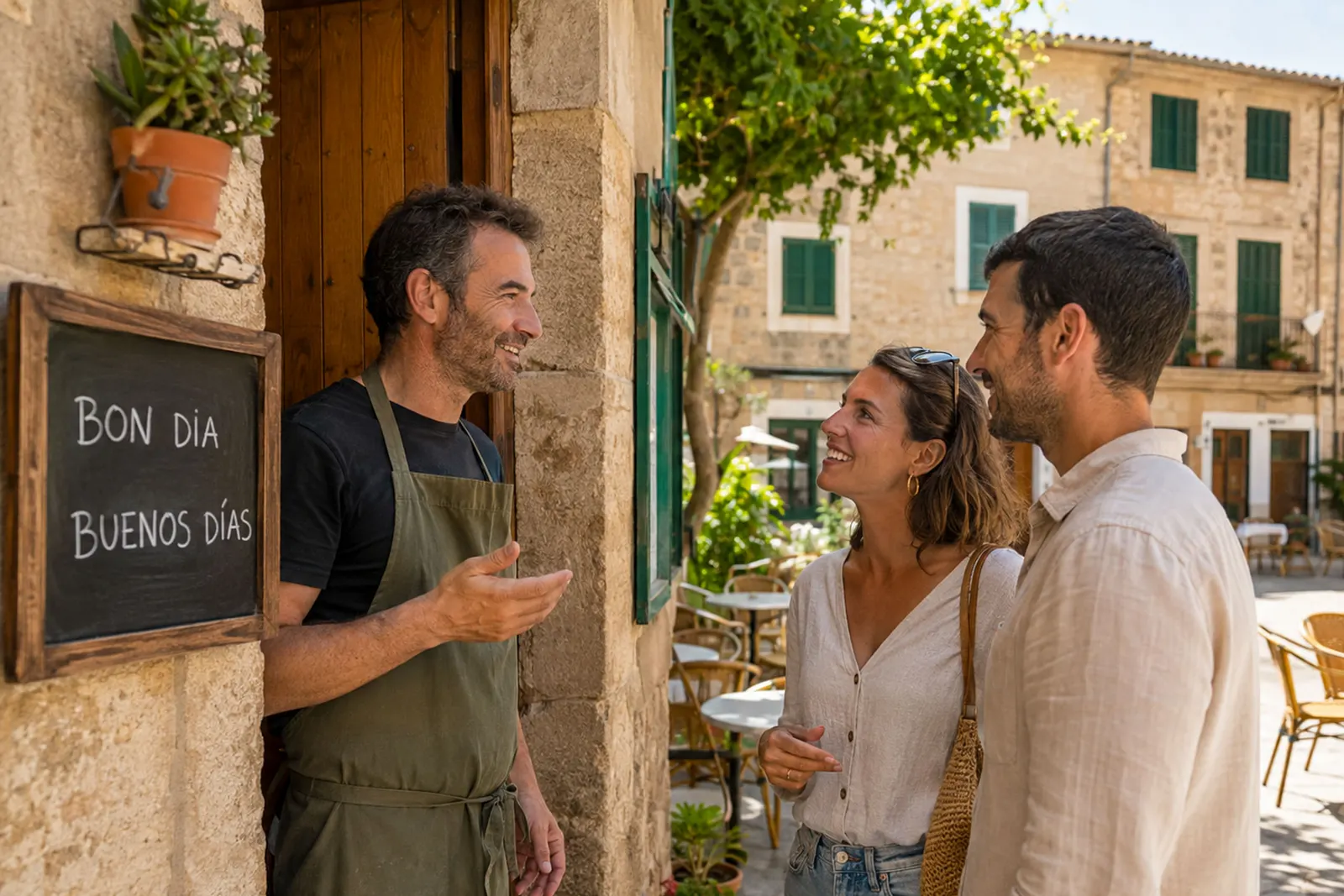
Bon dia and buenos días: two everyday greetings
Port or Puerto? Platja or Playa? A few local words make finding your way around Mallorca much easier.
On your first drive around Mallorca, you might spot a sign that doesn’t quite match your guidebook. Often you haven’t taken a wrong turn at all. You’re looking at another name for the same place.
Mallorca or Majorca?
Both names refer to the same island. Majorca is the traditional English spelling, still familiar in British holiday brochures. Mallorca is the local spelling, which we use throughout this guide.
Two official languages
Catalan and Spanish are both official languages in the Balearic Islands. The variety of Catalan spoken in Mallorca is called Mallorquí. It has its own familiar sounds and expressions, including the articles es and sa, where standard Catalan uses el and la.
Catalan names are common on official signs. Spanish names and older spellings also appear in maps and guidebooks. Sometimes the difference is simply a spelling variation, rather than a different language.
Palma or Palma de Mallorca?
The official name is Palma. It changed back from Palma de Mallorca in 2016, although the longer name is still widely recognised. On the island you may hear Ciutat — “the city”. Part Forana refers to the rest of Mallorca outside the capital.
Same place, different name
Names you might recognise
| Local name | Another version | Worth knowing |
|---|---|---|
| Palma | Palma de Mallorca | The official name has been Palma again since 2016. The longer name is still widely used. |
| Maó | Mahón | The capital of neighbouring Menorca has the same pattern of alternative names. |
| Sóller | Sóller | Some names are the same in both languages. The accent is still part of the name. |
| Sa Pobla | La Puebla | Sa is a characteristic Mallorcan article. The two names refer to the same town. |
| Santanyí | Santañy | Catalan ny corresponds to Spanish ñ. |
| Cala Rajada | Cala Ratjada | Both spellings occur. They are not simply a Catalan–Spanish pair. |
| Es Trenc | El Trenc | You will usually see the local form Es Trenc on signs. |
| Portocolom | Porto Colom | The name is sometimes written as one word and sometimes as two. |
Eighteen words to help you read a map
The words on Mallorca’s signs
- CalaCove
- PlatjaBeach
- PortHarbour
- PuigHill or mountain
- SerraMountain range
- TorrentSeasonal stream or watercourse
- CamíPath or road
- CarrerStreet
- PlaçaSquare
- EsglésiaChurch
- SantuariSanctuary or pilgrimage church
- ErmitaHermitage
- PossessióCountry estate
- Son / CanA house or estate, often followed by a personal name
- MiradorViewpoint
- Faro / FarLighthouse
- MercatMarket
- TorreTower
Son, Can, Es and Sa
You’ll often see Son or Can at the beginning of a house or place name. They frequently refer to a property and its former occupants. What follows might be a surname, a first name or a nickname, so the full story depends on the place.
Es and sa are characteristic Balearic articles, derived from the Latin ipse rather than ille. They’re one of the most recognisable features of Mallorquí.
A few words for your holiday
Nobody expects you to arrive speaking Catalan. But bon dia (good morning), gràcies (thank you), adéu (goodbye) and si us plau (please) are easy words to take with you. If you speak Spanish, that’s useful too.
The names in this guide
Mallorca Fritz generally uses the local Catalan place names you’ll see on signs, keeping their accents. Familiar alternatives help you recognise places you already know. Port d’Alcúdia, for example, is often called Puerto de Alcúdia in holiday brochures.
Your questions about language in Mallorca
What language do people speak in Mallorca?
Catalan and Spanish are both official languages. The local variety of Catalan is known as Mallorquí. You will hear both languages, and official place names and street signs are commonly in Catalan.
Is it Palma or Palma de Mallorca?
The official name has been Palma since the legal change in 2016. Palma de Mallorca remains widely used. On the island you may also hear Ciutat, meaning “the city”.
Why is the name on the sign different from my guidebook?
Some places have Catalan and Spanish names, while others have historical spelling variants. La Puebla and Sa Pobla, for example, are the same town. Not every spelling difference is a change of language.
What do Son and Can mean in place names?
They often refer to a house or estate and its former occupants. The name that follows may be a surname, a first name or a nickname.
Do I need to learn Catalan for my holiday?
No, but a few words help with maps and signs. Cala, Platja, Port, Puig, Camí, Carrer and Plaça are particularly useful. A friendly bon dia or gràcies is a nice way to begin a conversation.